

Food and wine · Thailand
Thai food: nine dishes to try in Thailand
A clay mortar thuds against the counter of a street stall, and strips of green papaya get lime, chilli and fish sauce before landing on your plate. In Thailand, food is often cooked right in front of you, and every region has its own kitchen.
In short
Thai cooking is about balancing sour, sweet, salty and hot, often within a single dish. Nine dishes give you a good map of the country: pad thai, tom yum, som tam, green curry, massaman, khao soi, mango sticky rice and two specialities from Phuket. Most are cooked at street stalls and cost very little.
Nine dishes to try
From street-stall noodles to the curries of the north and south. Tap a dish to read what it is and how to order it.
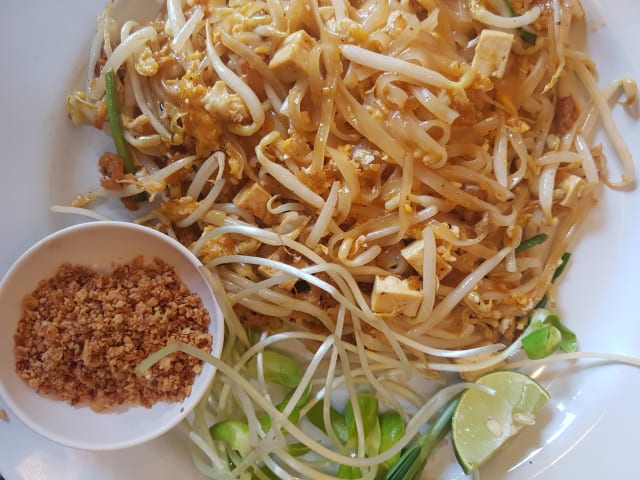 Photo: Iudexvivorum / Wikimedia Commons, CC0
Pad thai
Stir-fried rice noodles with tamarind, egg and prawns. Mild, and you season it yourself.
 Photo: JIP / Wikimedia Commons, CC BY-SA 4.0
Tom yum
Hot and sour soup with lemongrass, galangal and prawns. On UNESCO's heritage list since 2024.
 Photo: Alexander Klink / Wikimedia Commons, CC BY 4.0
Som tam
Green papaya pounded with lime and chilli. The salad of Isan, eaten with sticky rice.
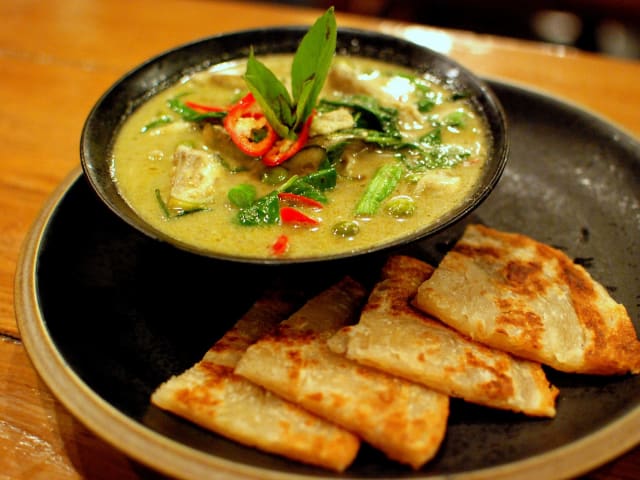 Photo: Takeaway / Wikimedia Commons, CC BY-SA 3.0
Green curry
Coconut curry with fresh green chillies and Thai basil. Often the hottest on the menu.
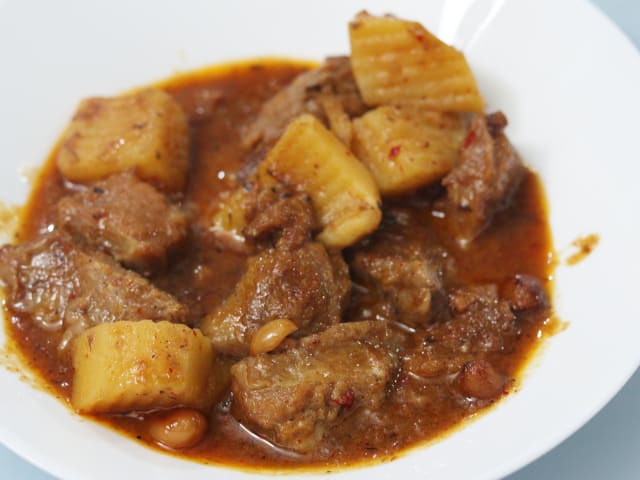 Photo: Vee Satayamas / Wikimedia Commons, CC BY-SA 4.0
Massaman curry
A mild curry with cinnamon, cardamom, potatoes and peanuts. An easy first choice.
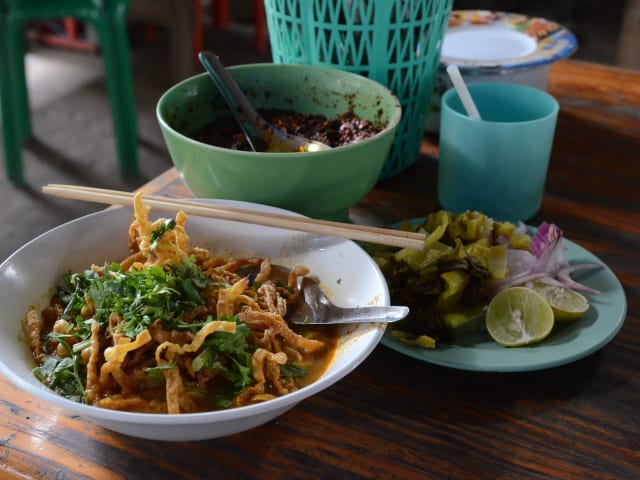 Photo: Takeaway / Wikimedia Commons, CC BY-SA 3.0
Khao soi
Egg noodles in curry broth with crispy noodles on top. Chiang Mai's own dish.
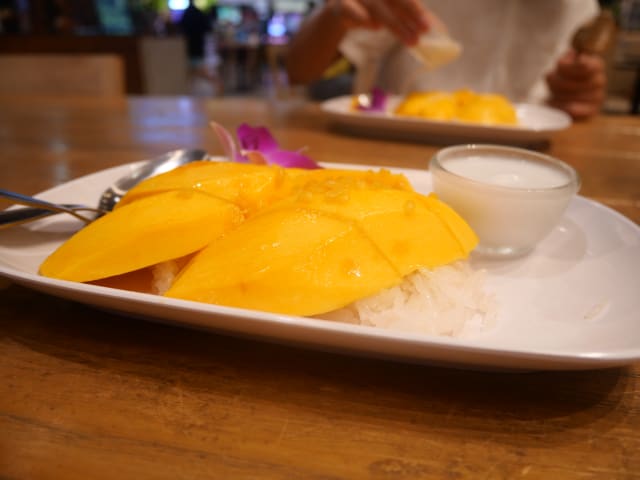 Photo: Arthur Taksin / Wikimedia Commons, CC BY 4.0
Mango sticky rice
Sticky rice with salted coconut cream and ripe mango. Best from March to June.
 Photo: Chunpeang1tan / Wikimedia Commons, CC BY-SA 4.0
Mee hokkien
Thick yellow noodles from Phuket, brought by tin miners from Fujian.
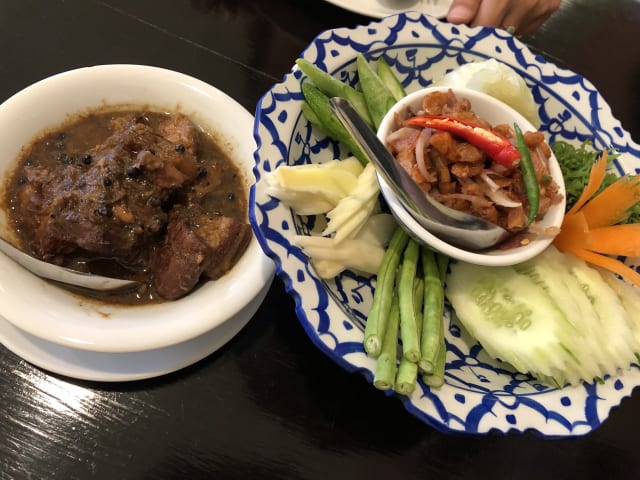 Photo: Chunpeang1tan / Wikimedia Commons, CC BY-SA 4.0
Moo hong
Pork belly braised in soy, black pepper and garlic. Phuket's comfort food.
Four kitchens in one country
The north: herbs and curry noodles
Around Chiang Mai the food is milder and more herbal, with influences from Myanmar and Yunnan in China. Khao soi, egg noodles in curry broth, is the city's signature dish.
The northeast: Isan and sticky rice
Isan borders Laos and shares much of its cooking. Sticky rice is eaten with your fingers alongside som tam, grilled chicken and larb, a salad of minced meat with lime and toasted rice.
Central Thailand: Bangkok and the rice plains
The cooking around Bangkok is what most Thai restaurants abroad serve. Coconut curries, wok dishes and pad thai belong here. The capital also cooks dishes from every corner of the country, brought by people who moved in from the provinces.
The south: fiery and Chinese-influenced
Southern curries are often hotter, heavy on turmeric and lighter on coconut. Chinese settlers and Muslim communities have shaped the food. In Phuket, yellow noodles and braised pork are everyday fare.
How to order
Thai meals are shared. Order several dishes for the table and rice for each person, rather than one plate each. You eat with a spoon in your right hand and a fork in your left, using the fork to push food onto the spoon. Chopsticks are for noodle soups.
If you want it mild, say "mai phet", which means not spicy. Most tables have a caddy with fish sauce and chilli, dried chilli flakes, sugar and vinegar, so you can adjust each dish yourself.
Where to eat well
Street stalls and markets are where Thais eat day to day, and many stalls cook just one dish. Hotel restaurants often tone the food down for visitors. Ask for it the way they make it for local customers.
Plenty of stalls take cash only. A cookery class usually starts with a walk round a market, which is where you learn the names of the herbs you have been tasting.
Frequently asked questions about Thai food
What is the national dish of Thailand?
Pad thai is often called the national dish, because the government promoted it as one in the late 1930s and 1940s. Many Thais would point to tom yum goong instead. The soup was added to UNESCO's list of intangible cultural heritage in 2024.
Which Thai dish is the least spicy?
Massaman curry, pad thai and khao man gai, chicken with rice cooked in stock, are among the mildest. Mango sticky rice has no chilli at all. Still ask, because cooks may add chilli to taste.
What do Thai people eat for breakfast?
Rice porridge is common, either jok, which is thick and smooth, or khao tom, a thinner rice soup. Many buy patongko, small deep-fried dough sticks, with sweet soy milk. Grilled pork with sticky rice is sold from stalls early in the morning.
What is the difference between red, green and yellow curry?
The colour comes from the curry paste. Green uses fresh green chillies and is often the hottest. Red uses dried red chillies. Yellow curry is rich in turmeric and usually the mildest of the three.




Photo credits
Street food in Chiang Mai: photo David McKelvey, Wikimedia Commons, CC BY 2.0. Cropped.
Pad thai: photo Iudexvivorum, Wikimedia Commons, CC0. Cropped.
Tom yum goong: photo JIP, Wikimedia Commons, CC BY-SA 4.0. Cropped.
Som tam: photo Alexander Klink, Wikimedia Commons, CC BY 4.0. Cropped.
Green curry: photo Takeaway, Wikimedia Commons, CC BY-SA 3.0. Cropped.
Massaman curry: photo Vee Satayamas, Wikimedia Commons, CC BY-SA 4.0. Cropped.
Khao soi: photo Takeaway, Wikimedia Commons, CC BY-SA 3.0. Cropped.
Mango sticky rice: photo Arthur Taksin, Wikimedia Commons, CC BY 4.0. Cropped.
Mee hokkien: photo Chunpeang1tan, Wikimedia Commons, CC BY-SA 4.0. Cropped.
Moo hong: photo Chunpeang1tan, Wikimedia Commons, CC BY-SA 4.0. Cropped.