

Food & wine
Seafood in Gothenburg: Feskekörka, oysters at VRÅ and Sjömagasinet
Chef Sofia B. Olsson at VRÅ went out and fetched the maligned Pacific oyster herself when no supplier would. We meet her, and show you the way to Feskekörka, the fish auction and Sjömagasinet.
1 November 20265 min read

Picolo Editorial
Picolo has a commercial partnership with Strawberry.
The taste of minerals, salt and the Swedish west coast. Sofia is standing in the archipelago and has just opened her first Pacific oyster, also known as the Japanese oyster: the wild oyster that has been criticised and feared. Many see it as an alien species, and some want the invader wiped out.
But Sofia discovers that it has a wonderful texture. A little firmer than ordinary oysters, slightly bigger and a little lumpier. More real. Sofia is fascinated. The Japanese newcomers have to go on the menu at VRÅ in Gothenburg.
All her regular suppliers refused to deliver Pacific oysters. Then Sofia met Lotta Klemming. The diver had seen the abundance of oysters along the whole coast herself, and wondered why nobody picked them.
Sofia was convinced, and had found two of her greatest visions in one: a woman leading the way in a male-dominated profession, and a sustainable ingredient everyone else saw as useless.
In short: seafood in Gothenburg
Feskekörka by the Rosenlund Canal is the city’s fish hall from 1874, with fish counters and four restaurants since its renovation in 2024. To see the catch come in, take an early morning tour of the fish auction at Fiskhamnen. For dinner, VRÅ at Clarion Hotel Post and Sjömagasinet in Klippan are two of the best-known seafood addresses.
Our first choice for a seafood weekend: Clarion Hotel Post by Centralstationen, with VRÅ under the same roof. Check availability and prices at Clarion Hotel Post
Vrå
Chef Sofia prepares the popular oysters at the restaurant VRÅ.
Role model of the year: Strawberry stands for equality
Together with her colleague Frida Ronge, Sofia B. Olsson is a chef that Strawberry’s owner, Petter Stordalen, firmly believes in. Both grew up with a genuine interest in seafood and have earned Stordalen’s trust. Sofia and Frida started VRÅ at Clarion Hotel Post in Gothenburg together, and today Sofia runs it on her own.
As well as running one of the city’s best seafood restaurants, Sofia is known for speaking up for equality, education and good leadership in the restaurant industry. For her, the passion for seafood and the passion for equality go together:
‘I push uncomfortable topics and challenge the macho culture. It’s important to fight for equality and an inclusive restaurant environment.’

In 2022, stories of sexual harassment at a well-known restaurant in Sweden came to light. It prompted Sofia and several chefs and bar owners to rally around the hashtag #härtardetslut (‘it ends here’). She later became chair of the association Framtidens Krogkultur, which works for a fair and attractive industry, free of abuse and harassment. Sofia points out that she chose Strawberry on purpose, because it is an employer with zero tolerance of sexism, racism and homophobia.
‘But everything is actually connected. What drives me is the vision of a restaurant that is sustainable in every way, from locally sourced, organic ingredients to the finances, and that includes social sustainability,’ says Sofia, and pauses.
‘Of course problems always come up, like harassment or not being able to get hold of oysters … and then I focus on solving them based on my vision. It’s about sustainability throughout the restaurant.’

A striking hotel setting
While we talk, Sofia shows us why VRÅ has earned its name as one of Gothenburg’s best restaurants. The ingredients come from local sea and land, with inspiration from Japan. The vegetables are grown on the roof of Clarion Hotel Post, and both restaurant and hotel are housed in the old post office, where the historic meets the new.
‘It’s a really striking setting,’ says Sofia.
The menu is built on the best ingredients of the season: fish, sashimi and, not least, oysters.
So we have to go back to the sea. Just before Sofia tasted the Japanese oysters for the first time, she had taken the whole team to Grebbestad. They wore waders and diving masks. In the water lay Lotta Klemming in her diving gear. She was the one they had come to see and learn from.

‘It’s completely mad!’
At the start of the 2000s, the Japanese oyster spread along the whole west coast of Sweden. Everyone saw it as a threat, Sofia explains, but she wondered what the difference really was from the oysters already there. The French ones looked exactly the same.
‘I did some research, and it turned out they were exactly the same species. We had an abundance on the west coast while importing tonnes of the same species from France every year.’
‘It’s completely mad. We should be eating what’s local. So I checked with suppliers, but nobody could deliver,’ says Sofia. ‘Until I found Lotta, that is.’
‘It was a match made in heaven.’

The chef’s ultimate meal
Lotta is a third-generation oyster diver and the only woman in Sweden in her profession. She had the same thoughts as Sofia. Why not sell the oysters the west coast had in abundance? Together they picked and tasted, and concluded that the flavour was even better than the French ones.
‘We think they’re absolutely fantastic oysters.’
Sofia ordered oysters from Lotta, who dived, picked, cleaned and delivered them in wooden crates to VRÅ. They were the first to serve the maligned oyster.
Things moved quickly. The two women were invited to lecture on the Pacific oyster in London, Stockholm and on Gotland, inspiring others and spreading the word about the new oyster.
‘It became a trend that spread quickly internationally. Now everyone has Japanese oysters, from fish shops to fine restaurants. It means shorter transport, it’s better for the marine environment, and it’s a win-win all the way. There isn’t much food that is only positive, but this is,’ says Sofia.
And that is exactly what the chef would call the ultimate meal: eating at a restaurant that gets every part right.
‘The food is delicious, you know the seafood is local and properly sourced, and you’ve heard from friends that the staff are kind to each other in the kitchen. You can enjoy it all with a clear conscience!’
From the fish auction to the table
The portrait of Sofia is about one oyster. If you want to taste more of the west coast, these are the places we would start with.
Feskekörka: the fish church by the canal
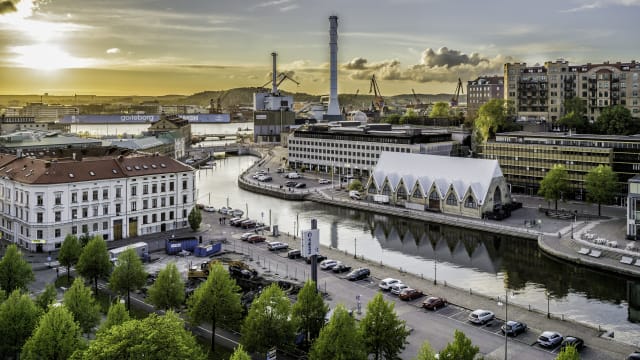
City architect Victor von Gegerfelt designed the fish hall to look like a church, and it opened on 1 November 1874. After four years of renovation it reopened in May 2024, now with a single operator for the whole building. The fish counters are still there, alongside the restaurants Lilla Åstols Rökeri, Haldis Kök, Ekmans and Victor von G. There is more restaurant and less market trading than before. The address is Fisktorget 4.
Fiskhamnen: an auction before breakfast
The fish auction moved from Feskekörka to Fiskhamnen in 1910, and Göteborgs Fiskauktion is now the largest in Sweden. Every weekday morning, fishmongers and wholesalers gather to bid on the night’s catch. Sjömatsfrämjandet runs guided tours early in the morning for 100 Swedish kronor, and places must be booked in advance.
Sjömagasinet: dinner in a warehouse from 1775
The restaurant is in a warehouse that once belonged to the Swedish East India Company, in the Klippan heritage area by the harbour entrance. Ask for a table on the first floor, where you look out over the harbour. Sjömagasinet is in the Michelin Guide and scored 89 points in the Falstaff guide for the Nordics 2026. The address is Adolf Edelsvärds gata 5, about four kilometres from the centre.
VRÅ: Japanese technique, west coast ingredients
VRÅ at Clarion Hotel Post combines Japanese cooking with fish, shellfish and seaweed from the west coast. Both the restaurant and the hotel carry the Nordic Swan Ecolabel. Sofia B. Olsson has run the kitchen since it opened in 2012.
Where to stay for a seafood weekend
VRÅ is by Centralstationen, and Feskekörka is a short walk away. Stay in the centre and you can reach both on foot.

Clarion Hotel Post: oysters and a lift up to your room
Clarion Hotel Post is in the 1925 post office by Centralstationen, and VRÅ is one of the hotel’s two restaurants. After dinner you take the lift upstairs, and in the morning the pool and spa are in the same building. Made for anyone who wants the oyster dinner to be the whole evening.

Hotel Eggers: historic on Drottningtorget
Hotel Eggers, from 1859, is one of Sweden’s oldest hotels and stands right across the square from Centralstationen. Chandeliers and wallpaper give it the feel of another era, and to reach VRÅ you only have to cross Drottningtorget. A good fit if you arrive by train and want somewhere historic without dragging your suitcase far.

Hotel Flora: next door to the fish hall
Hotel Flora is a small boutique hotel on Grönsakstorget, a few minutes’ walk from Feskekörka and the canal. The bar and bistro serve Swedish classics, so you have somewhere to end the evening after the fish hall closes. Suited to couples who want somewhere small and central, with Haga and Linné within reach.

Planning a longer trip? Read our guide to things to do in Gothenburg and see the ten best hotels in Gothenburg.
Our first choice for a seafood weekend
Clarion Hotel Post
Clarion Hotel Post is home to VRÅ, so you can eat oysters and west coast seafood and take the lift up to your room afterwards. Rooms range from compact doubles to suites with a lounge. The Skönhetsfabriken spa has a pool and saunas, and from the post office on Drottningtorget it is around twenty minutes on foot to Feskekörka. Book a table at VRÅ when you book the room, especially for Friday and Saturday.


Frequently asked questions about seafood in Gothenburg
What is Feskekörka?
Feskekörka is Gothenburg’s fish hall by the Rosenlund Canal, opened in 1874 and designed to look like a church. After four years of renovation it reopened in May 2024 with fish counters and four restaurants under one roof. The address is Fisktorget 4, a short walk from the centre.
Can you visit the fish auction in Gothenburg?
Yes. Sjömatsfrämjandet takes groups on guided tours of Göteborgs Fiskauktion at Fiskhamnen early in the morning, and the tour costs 100 Swedish kronor. Places are limited and must be booked in advance. Bring warm clothes, as the auction hall is kept cold.
What is a Pacific oyster?
The Pacific oyster, also called the Japanese oyster, is a wild oyster that has spread along the west coast and is seen by many as an alien species. It is a little firmer, larger and lumpier than the native oyster, with a mineral, salty flavour.
Where is the restaurant VRÅ?
VRÅ is at Clarion Hotel Post by Centralstationen in Gothenburg. The restaurant combines Japanese cooking with ingredients from the west coast, and chef Sofia B. Olsson has run it since it opened in 2012.
Where should I stay for seafood in Gothenburg?
Clarion Hotel Post is the easiest choice, since VRÅ is in the building. Hotel Eggers is just across Drottningtorget, and Hotel Flora on Grönsakstorget is closest to Feskekörka. For Sjömagasinet in Klippan, take the tram or a taxi from the centre.
Sources
Menus and bookings are on the restaurants' own websites, and Göteborg & Co has more food tips for the city. Tram and bus timetables are on Västtrafik, and the weather forecast is from SMHI. Room types, facilities and guest ratings come from Hotels.com and the hotels' own websites, last checked in November 2026. The selection and the advice are Picolo's own. This page was last reviewed in November 2026.


More travel stories

Christmas, Denmark, Hotels, Sweden
A Scandinavian Christmas feast: Copenhagen, Gothenburg or Stockholm
The schnapps is ice cold in Copenhagen, the herring jars stand in rows in Stockholm, and in Gothenburg the Christmas table tastes of the sea. Three cities, three very different feasts.
- October 29, 2026

Christmas, Hotel, Norway, Skiing, Sweden
Christmas and New Year in the mountains: the Scandinavian ski hotels to book now
Snow on the ground, a fire in the lounge and skiing right outside the door. If you want to spend Christmas or New Year at a mountain hotel in Norway or Sweden, these are the hotels we would choose, and this is why you should book now.
- October 16, 2026

Hotel, Norway, Skiing, Ski resort, Sweden
Ski-in, ski-out in Norway and Sweden: hotels where the slope starts at the door
The best thing about a ski-in, ski-out hotel is that the car can stay parked all week. These are the hotels in Norway and Sweden where you clip into your skis outside and ski straight home when the lifts close.
- October 16, 2026

Åre, Hotel, Skiing, Ski resort, Sweden
Copperhill Mountain Lodge in Åre: the design hotel at the top of Förberget
Copperhill sits at the top of Förberget in Åre, with Åreskutan across the valley and the slopes right outside. The hotel was designed by the architect behind the Apple stores. Here is what to know before you book.
- October 15, 2026

Skiing, Ski resort, Sweden
Sälen: family skiing in Dalarna and where to stay
Four ski areas, Sweden’s largest collection of Alpine slopes and the starting line of the Vasaloppet. This is Sälen in Dalarna, and the hotel with ski-in/ski-out access.
- October 09, 2026

Gothenburg, Hotel, Sweden, Weekend
A weekend in Gothenburg: three hotels and a plan for two nights
You land at Landvetter on Friday afternoon, and the airport bus drops you in the centre. By evening you have checked in and found a table for street food and a beer from one of the city's breweries.
- November 01, 2026