

Cities
The Guggenheim Museum in Bilbao: one of the world's most famous buildings
Bilbao has gone from being a dirty industrial city to a clear favourite on many people's bucket list. This is the story of how a single building changed an entire city.
1 November 20266 min read

Adrian Møller Haugan
In short: the Guggenheim Museum Bilbao
The Guggenheim Museum Bilbao was designed by Frank Gehry and opened in 1997, and it turned an industrial city into a destination. Allow two to three hours, buy tickets online, and walk around the building to see the Maman spider and the Puppy flower dog outside.
The assignment was simple, yet difficult: "You are given free rein, but it must be challenging, ground-breaking, and innovative."
That was the brief Canadian architect Frank Gehry was given in the 1990s when he was brought in to pitch his vision of the new Guggenheim Museum in Bilbao, Spain. The architect was known for unusual buildings. Among other things, his own house in Santa Monica, California, had become the talk of the architectural community worldwide. In other words, the then 60-year-old architect seemed the obvious candidate to design the new landmark building.

Frank Gehry: architect of the Bilbao Guggenheim
The Basque delegation may not have been fully prepared for what was to come. Juan Ignacio Vidarte is the current director general at the Guggenheim in Bilbao and attended the first meetings where Gehry presented rough sketches of the museum.
"There was a lot of 'oh my God, what is this?' in the beginning. But as we understood the process, there was a consensus that this was the right project," Vidarte told Time Magazine in March 2023.
Read related articles: 24 hours in Spanish Bilbao? What you need to see
But the director of the Solomon R. Guggenheim Foundation, Thomas Krens, had no doubt that Gehry was their man. Little did Krens know that he, Gehry, and everyone else involved in the project would change architecture, culture, and tourism forever.
Want the museum outside your window? See our guide to hotels near the Guggenheim.
What Bilbao was like in the 1980s
It was certainly not a foregone conclusion that Bilbao would become the new hometown of the Solomon R. Guggenheim Foundation's new museum. In the 1980s, when plans were first discussed for opening a new museum abroad, Bilbao was not a cultural destination.
Read related articles: Chasing his third Michelin star in the world´s most premier food city

The formerly proud and rich port city in the far north of Spain was in decline, largely as a result of fierce and cheaper competition from abroad. Factories and shipyards closed down at record speed. Unemployment was sky-high, at around 25 percent, and the city struggled with major social problems such as drug abuse and violence.
In addition, the old, abandoned industrial areas were polluted.
"At the time, it was a much greyer and dirtier city. The air was heavily polluted as a result of emissions from the steel factories and shipyards located in the city centre," the current mayor of Bilbao, Juan Mari Aburto, told The Guardian.

"I remember a terribly dirty estuary, and it wasn't just due to the industrial activity in the city. There was no proper sewage system. The smell coming from the water was quite unbearable," Aburto recalls of growing up there.
Read related articles: Where to stay in Bilbao
In addition, the Basque separatist group, Euskadi Ta Askatasuna (ETA, Basque Homeland and Liberty), spread fear with a series of terrorist attacks throughout the country. In 1989, they killed three police officers with a car bomb in downtown Bilbao.
In other words, something had to be done.

Bilbao: a controversial decision
The Solomon R. Guggenheim Foundation, in turn, had other candidate cities in Switzerland, Germany, and Japan as potential locations for their new museum abroad. Barcelona had also been discussed, but the city was busy preparing for the 1992 Summer Olympics. A new, expensive art museum was the last thing it needed to consider.
That's when the authorities in Bilbao saw their opening. They took a chance and invited the foundation's director, Thomas Krens, to town. They talked about the new metro system that was to come, as well as how green parks, pedestrian streets, and new buildings would breathe new life into former industrial areas. The city also planned to clean the Nervión River after years of pollution. The whole city was to be revitalized.

The Guggenheim's new home
Director Krens was no stranger to making controversial decisions. Art lovers in the United States had previously criticized him for commercializing the Guggenheim, focusing too much on expanding abroad and not enough on art. To him, such criticism was like water off a duck's back.
Krens fell head over heels for Bilbao's charm offensive and in 1991 the director signed an agreement with the local authorities in Bilbao. The city would foot the bill for the building itself, the site, and the costs associated with exhibitions, while the Guggenheim Foundation was responsible for lending artworks and operations. In addition, the City of Bilbao would subsidize the museum with an annual sum of $12 million in its budget.
Read related articles: Bilbao old town: the Casco Viejo and pintxos

In total, the financial package was around $230 million (equivalent to about $440 million in 2023). Many critical voices believed the money should rather be spent on a range of social initiatives than on a new art museum. Many also believed it was a scandal that the Guggenheim did not focus primarily on Basque art.
However, the brains behind the project could not be stopped. Joseba Arregi, Basque culture minister at the time, stated that "the sum was lower than what it would cost to build one kilometre of new motorway".

The Guggenheim was to be like the Sydney Opera House
After a pitching competition, where three established architects presented their vision for the building, Frank Gehry got the job. Although the job was simple on paper, Thomas Krens had cited the Sydney Opera House as a source of inspiration for what they were looking for.
"We were going to set a precedent for what a museum could look like in the 21st century," the former museum director said in a television interview.
Read related articles: 48 hours in San Sebastián

Gehry, for his part, revealed in an interview with The Guardian on the 20th anniversary of the building that he felt the pressure that came with the job.
"They said, 'Mr Gehry, we need the Sydney Opera House. Our city is dying.' I looked at them and said, 'Where's the nearest exit?' I promised to do my best but said I couldn't guarantee anything."
Read related articles: Hotels near the Guggenheim in Bilbao
Guggenheim: an instant success
The wavy shapes were chosen by the architect as an imitation of a fish's movement in water, a source of inspiration that is a common thread in Gehry's work. Many have pointed out that the untraditional choice to cover buildings in titanium plates can also resemble fish skin. The plates also change colour according to how sunlight reflects on them

The building itself looks like a ship, especially from the opposite side of the Nervión, another nod to Bilbao's maritime history.
After years of planning and construction, the Guggenheim in Bilbao opened its doors in 1997. Gehry's concerns about not living up to expectations turned out to be groundless. The architect stayed within budget, and the museum was an instant success. The opening itself was attended by over 5,000 people.
Before opening, the initiators had dreamed of attracting around 500,000 visitors a year, but 1.3 million people visited the Guggenheim in its first year alone. During its first three years, more than four million people visited the museum.

The Bilbao effect: how it changed a city
Bilbao's revitalization continued over the next few years. Several extraordinary new buildings and bridges and general urban development has taken place. This has led to the Basque city becoming a destination for people all over the world, especially known for its art, culture, and architecture.
The phenomenon of this turnaround from being a city many outside Spain had barely heard of to one of the world's foremost cultural cities has been coined 'the Bilbao effect'. Also known as the "Bilbao miracle", this is defined as when a single building changes an entire city.

The current director of the Guggenheim Foundation, Richard Armstrong, stated in a 2017 interview with Artnet that the museum's greatest achievement is how it changed both tourists and its own residents' perception of Bilbao as a city.
"The greatest success of the Guggenheim in Bilbao is that it demonstrates the impact visual arts can have on a city's ability to attract visitors while positively changing its own psychology. In the 1990s, the city was difficult to travel to and navel-gazing. It was not attractive to foreign visitors.

Not just the museum
Today, 25 years after the opening of the world-famous building, not everyone agrees that the Guggenheim Museum single-handedly saved Bilbao from going under.
"We cannot attribute Bilbao's change solely to its arrival. But the Guggenheim Museum was the engine of change, as well as a host of other important elements. The whole city has changed in a way that is unprecedented in an international context.
Read related articles: 24 hours in Bilbao
The fact that we managed to clean up the pollution that had occurred in the estuary and the environment, including with an investment of over one billion euros, was also part of it," current mayor Juan Mari Aburto said in 2022 when The Guardian asked him what he thought of the term 'Bilbao effect'.

The current director general of the Guggenheim in Bilbao, the Basque Juan Ignacio Vidarte, is also unsure how much one can credit the museum as the city's saviour.
Put Bilbao firmly on the map
"This project was part of a much larger plan, and it fit perfectly with the overall plan. It didn't happen on its own, the museum wasn't just a random whim we got," Vidarte said in the same interview.

Phenomenon or not, there is no doubt that the Guggenheim has firmly put Bilbao on the map. Few cities in the world are as synonymous with a signature building as the Guggenheim and Bilbao. Since its opening in 1997, it has had almost 25 million visitors, is said to have contributed to over 5,000 jobs locally and generated over 650 million euros for the Basque treasury.
The museum is also among Spain's most visited, and regularly appears in films and music videos. It has also become a milestone for established artists to have their works exhibited in the landed "boat".

Not bad considering what Gehry himself thought when he saw the building a month before it opened in 1997.
"I came over the hill and saw it (the Guggenheim Museum) shining there. Then I was like, 'What the fuck have I done to these people?'."
Editor's note: The airline Norwegian covered air travel expenses in connection with this article. Picolo makes its own editorial choices, freely and independently.
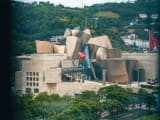
The hotel we photographed from
Hotel Miró
Picolo’s photographer took the pictures of the museum from above from the window of a room at Hotel Miró. The hotel is a few minutes from the Guggenheim, and from the upper floors you see the titanium above the trees in the park. The spa offers massage, aromatherapy and hydrotherapy, and the gym is open around the clock. From here you walk to the museum in the morning and to the Bellas Artes fine arts museum in the afternoon. Book a room on an upper floor and you see the Guggenheim the way we did.


Stay near the Guggenheim
To see the museum in the morning light before the doors open, or walk the river when the facade glows at night, stay nearby.
The Artist Grand Hotel of Art
The former Gran Hotel Domine stands opposite the museum, with a roof terrace, a spa and two restaurants. The closest you can sleep to Gehry’s building.
Hotel Miró
The design hotel a few minutes from the museum has a spa and a 24-hour gym, with views across the park from the upper floors.
Vincci Consulado de Bilbao
Five minutes from the museum on foot, with a roof terrace and a restaurant serving local dishes. A good choice at a lower price.
Compare them in our guide to hotels near the Guggenheim, or see where to stay in Bilbao.
Frequently asked questions about the Guggenheim Museum Bilbao
Who designed the Guggenheim Museum in Bilbao?
The museum was designed by the Canadian-American architect Frank Gehry, who won the commission in the 1990s. He was given free rein, but the building had to be challenging, groundbreaking and innovative. The curving titanium panels were inspired by the movement of fish in water. It opened in October 1997.
How did the Guggenheim change Bilbao?
In the 1980s Bilbao was a grey industrial city with closed shipyards, high unemployment and pollution. The museum became a landmark that drew 1.3 million visitors in its first year. The phenomenon is known as the Bilbao effect, although the city also cleaned up the river and built a new metro.
Where should I stay when visiting the Guggenheim?
The Artist Grand Hotel of Art stands opposite the museum, and Hotel Miró is a few minutes away with views over the park. Both have a spa. Vincci Consulado and Meliá are good choices a little further away. See our guide to hotels near the Guggenheim for which rooms to book.
How long do you need at the Guggenheim Museum?
Allow two to three hours inside, and half an hour for the sculptures outside: Puppy, Maman and the fog sculpture by the river. Buy tickets online to skip the queue. The museum usually closes on Mondays outside the summer, so check opening hours before you go.
Art & Culture, Bilbao, Cities, Spain
The Guggenheim Museum in Bilbao: one of the world's most famous buildings
Bilbao has gone from being a dirty industrial city to a clear favourite on many people's bucket list. This is the story of how a single building changed an entire city.
- October 09, 2026

Food & Wine, San Sebastián, Spain
A foodie weekend in San Sebastián: hotels near the Michelin restaurants
A weekend in San Sebastián is planned around the tables. These are the hotels closest to the starred restaurants, and how to put the weekend together.
- October 31, 2026

Spain, Sun
Spain weather: temperature month by month
In January you can have lunch outdoors in Málaga, but you will want a jacket once the sun goes down. Spain has more than one climate: Seville bakes in summer, Alicante and Málaga are the warmest places on the mainland in winter, and the Canary Islands are warmest of all from November to March. Here are the official AEMET averages, place by place and month by month.
- November 12, 2026

Luxury Hotel, San Sebastián, Spain
Luxury hotels in San Sebastián: grand hotels, villas and spas
From Belle Époque by the river to rooms beside a three-star restaurant. These are the most exclusive hotels in San Sebastián, and what sets them apart.
- October 31, 2026

Barcelona, Family, Spain
Barcelona with kids: beach, aquarium and a funfair on a mountain
Barcelona is one of the easiest big cities to visit with children. The beach is in town, and the aquarium, zoo and science museum are a short ride away. Here is what we would prioritise, and where we would stay.
- October 29, 2026

Beaches, Spain
The best beaches in Spain, from Formentera to Galicia
Spain has island coves, dune-backed Atlantic sand and city beaches you can walk to after breakfast. These are the ones worth planning a trip around, and where to stay nearby.
- October 28, 2026

Hotels, San Sebastián, Spain
Budget hotels in San Sebastián: guesthouses and hotels in good locations
San Sebastián is expensive, but you do not need to pay grand hotel prices to stay centrally. These are the guesthouses and good-value hotels we recommend.
- October 31, 2026

Beach Hotel, San Sebastián, Spain
Beach hotels in San Sebastián: stay with La Concha outside
Three city beaches, three different moods. These are the hotels where you can walk straight onto the sand, from the La Concha promenade to the surf beach in Gros.
- October 31, 2026

Barcelona, Day trip, Spain
Day trips from Barcelona: Montserrat, Sitges, Girona and the Costa Brava
A monastery in a jagged mountain, a whitewashed beach town and a medieval city on a river. Some of the best days of a Barcelona trip happen outside the city. Here are the day trips we recommend, how to get there and where to stay the night.
- October 09, 2026

City, Culture, Spain
Girona: the medieval city on the river, 40 minutes from Barcelona
Colourful houses over the river, a cathedral with the widest Gothic nave in the world and one of the world’s best restaurants. Girona is one of Spain’s best-preserved medieval cities. Here is what to see, and where to stay.
- October 09, 2026
Beach, Nature, Spain
The Costa Brava: coves, fishing villages and hotels on the wild coast
Small coves with crystal-clear water, whitewashed fishing villages and a coastal path from beach to beach. The Costa Brava north of Barcelona is one of the most beautiful coasts in the Mediterranean. Here are the places we recommend, when to go and where to stay.
- October 09, 2026

Mallorca, Spain
Best time to visit Mallorca: weather month by month
The best time to visit Mallorca is late May, June or September, when the sea is warm and the island is calmer than in high summer. Here is what each season offers.
- November 13, 2026
Showing 1 to 12 of 34 articles
- 1
- 2
- 3