

Neubau
The MuseumsQuartier, Biedermeier lanes in Spittelberg and shops along Neubaugasse.
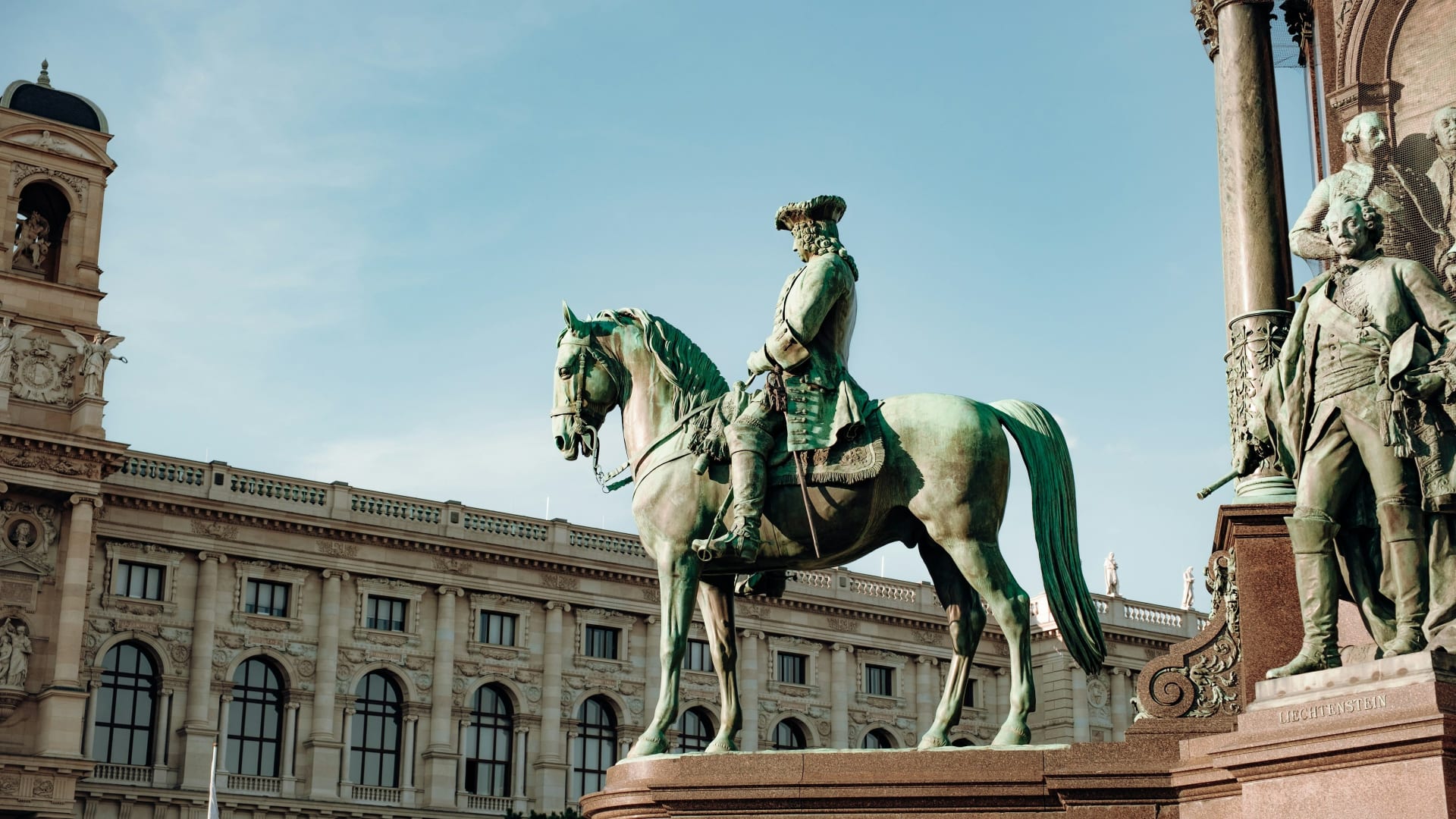
The Ringstrasse is a circular boulevard of 5.3 kilometres around the Innere Stadt. In 1857 Emperor Franz Joseph ordered the city walls and moats pulled down, and palaces, museums and a parliament rose on the land. Building was not finished until 1913. Karlsplatz lies just outside the Ring, and belongs naturally with it.
The core inside the Ring is covered in our guide to Innere Stadt. For the whole city, see the Vienna travel guide.
The Opera opened on 25 May 1869 with Mozart's «Don Giovanni». It was hit in a bombing raid on 12 March 1945 and reopened on 5 November 1955 with «Fidelio». The architects were August Sicard von Sicardsburg and Eduard van der Nüll.

The city hall was built between 1872 and 1883 in neo-Gothic style, with a tower of 98 metres. The Vienna Christmas markets are held on the Rathausplatz in front. A little further on lies the Stadtpark, opened in 1862, with the gilded statue of Johann Strauss unveiled in 1921.

The museum on Maria-Theresien-Platz opened in 1891. It holds several works by Pieter Bruegel the Elder, among them «The Tower of Babel» and «The Hunters in the Snow». The Natural History Museum stands directly opposite, in a near-twin building.

The Karlskirche was built between 1716 and 1737, after Emperor Charles VI vowed a church during the plague of 1713. The dome is about 70 metres high, and the two columns in front carry spiral reliefs inspired by Trajan's Column in Rome. Beside the square stands the Musikverein, opened in 1870, home of the annual New Year's Concert.

Otto Wagner's two Stadtbahn pavilions date from around 1900, and one is now a café. The Secession building of 1897 to 1898 holds Klimt's Beethoven Frieze, made for the 1902 exhibition.

Day 1: tram 1 or 2 round the Ring, with stops at the Opera and the Rathaus.
Day 2: the Kunsthistorisches Museum in the morning and Karlsplatz in the afternoon.
Day 3: the Secession, then across to Neubau and the MuseumsQuartier.
The Ring suits you if you want the big city outside the door and do not need a local neighbourhood. Traffic on the Ring is steady all day. For quieter nights, look to the side streets towards Innere Stadt.

The marble staircase rising from the lobby of Hotel Imperial tells you what kind of house you have entered, because the hotel was built as a palace. It stands on Kärntner Ring, a block from the Opera, with the tram at the kerb. Rooms on the top floors are smaller and plainer than those below, so check what you book. If you want informal and young, this is the wrong place.
More suggestions are among the hotels in Vienna.
Trams 1 and 2 run part of the way round the Ring. For Karlsplatz, take the U-Bahn on lines U1, U2 and U4. From the airport, trains run to Wien Mitte, and from there it is a short way to the Ring.
The Ring is a busy road. Between the sights it is a walk along traffic, not a quiet promenade.
The full circuit is 5.3 kilometres, so allow half a day if you stop.
Karlsplatz is a traffic hub, and the square looks best next to the Karlskirche.
Area guides
Three districts, each with its own rhythm.
The MuseumsQuartier, Biedermeier lanes in Spittelberg and shops along Neubaugasse.
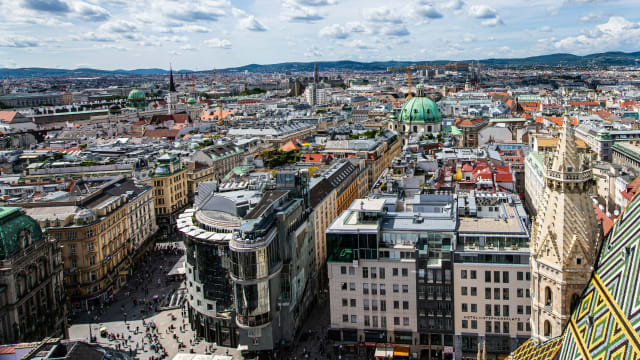
St Stephen's, the Graben, the Hofburg and the riding school on barely three square kilometres.
The Ringstrasse is 5.3 kilometres long and runs in a circle round the Innere Stadt. You can walk it, but most people ride tram 1 or 2, which run part of the way round.
Emperor Franz Joseph gave the order in 1857, with the words «Es ist Mein Wille». Building took decades and was finished in 1913, so the buildings along the road come from different periods.
Karlsplatz is known for the Karlskirche, the Musikverein and Wagner's Stadtbahn pavilions. The square lies in Wieden, just outside the Ring, and several U-Bahn lines meet here.
No, «The Kiss» hangs in the Belvedere, which lies outside the Ring. At Karlsplatz you can instead see Klimt's Beethoven Frieze in the Secession, made for the 1902 exhibition.
The Ringstrasse is the boulevard itself, while Innere Stadt is the district it encircles. You walk from St Stephen's to the Opera inside Innere Stadt, and on to the museums and parliament along the Ring.