

Charlottenburg
The palace from 1695, the church ruin on Breitscheidplatz and Kurfürstendamm.

Travel guide · Berlin
The Oberbaum Bridge over the Spree reopened to pedestrians and traffic on 9 November 1994, five years to the day after the Wall fell. Today you walk across it from Kreuzberg to Friedrichshain.
The Oberbaum Bridge is a red brick bridge from 1896 in North German Brick Gothic, designed by Otto Stahn. While the city was divided it marked the border between East and West. Today it links Kreuzberg and Friedrichshain, which have shared one borough since 2001.
Kreuzberg lay in West Berlin, enclosed by the Wall on three sides. Many residents have Turkish roots, and the district has a reputation as alternative and artistic. For the rest of the city, see our Berlin travel guide.
Walk across towards Friedrichshain and stop halfway for the view along the Spree. The U-Bahn runs on the upper level, so you hear it overhead. Trains on the upper deck started running again in 1995.
The canal crosses Kreuzberg from east to west. In summer people sit on the bank, and some paddle small inflatable boats. Walk along the water to see the district without a car.
The market hall on Eisenbahnstrasse opened in 1891 and reopened in 2011. On Thursday evenings there is street food from many countries, and on Fridays and Saturdays a regular market. Check opening times before you go.
The museum opened in 2001 in a building designed by Daniel Libeskind, with a zigzag plan and empty spaces called voids. The Holocaust Tower is an empty concrete silo 24 metres tall, and the Garden of Exile is a garden of tall concrete pillars. Set aside half a day.
The Kreuzberg hill is 66 metres high and gave the district its name. At the top stands an 1821 monument by Karl Friedrich Schinkel, and a 24-metre artificial waterfall runs down the slope. The park is a green break in the middle of the district.

Day 1: the Landwehr Canal and dinner around Oranienplatz.
Day 2: the Jewish Museum in the morning and Viktoriapark in the afternoon.
Day 3: Markthalle Neun, then across the Oberbaum Bridge to the East Side Gallery. More in our things to do in Berlin.
Orania.Berlin stands on Oranienplatz in a commercial building from 1913, with a bar and concerts on the ground floor. Across the Oberbaum Bridge, in Friedrichshain, you find the Michelberger Hotel. For quieter nights, Prenzlauer Berg is an alternative. See every pick in our Berlin hotel guide.
The U1 and U8 lines meet at Kottbusser Tor. For Markthalle Neun the nearest station is Görlitzer Bahnhof, and for the Jewish Museum you walk from Hallesches Tor. For Viktoriapark take the U6 or U7 to Mehringdamm.
Kreuzberg stays lively late. Ask for a room facing the courtyard if you want an early night.
Check which days the street food runs at Markthalle Neun before you plan your evening.
Check opening times and ticket rules for the Jewish Museum before you go.
Kreuzberg and Friedrichshain are still two different neighbourhoods, even though they share a borough name.
Area guides
See what the other districts are like.
The palace from 1695, the church ruin on Breitscheidplatz and Kurfürstendamm.
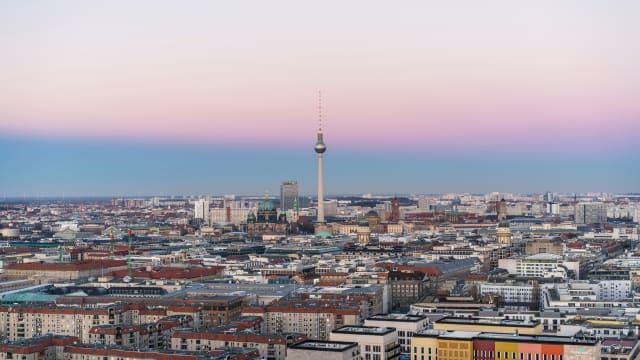
Museum Island, Gendarmenmarkt and the Hackesche Höfe sit close enough to walk between.

A water tower from 1877, an old brewery turned arts centre and a Sunday market at Mauerpark.
Kreuzberg is known for its canal, its markets, the Jewish Museum and a creative nightlife. The district lay in West Berlin, surrounded by the Wall on three sides, and many residents have Turkish roots.
Yes, if you want cafés, the canal and nightlife on the doorstep. The district stays lively late, so it suits you less if you want quiet evenings.
The market hall on Eisenbahnstrasse opened in 1891. It reopened in 2011, with street food on Thursday evenings and a market on Fridays and Saturdays. Check opening times before you go.
The district is named after the Kreuzberg, a 66-metre hill in Viktoriapark. The king gave the hill that name when the monument at the top was unveiled in 1821.
Walk across the Oberbaum Bridge, a red brick bridge from 1896 with the U-Bahn on its upper level. From Schlesisches Tor to Warschauer Strasse takes under 20 minutes on foot.