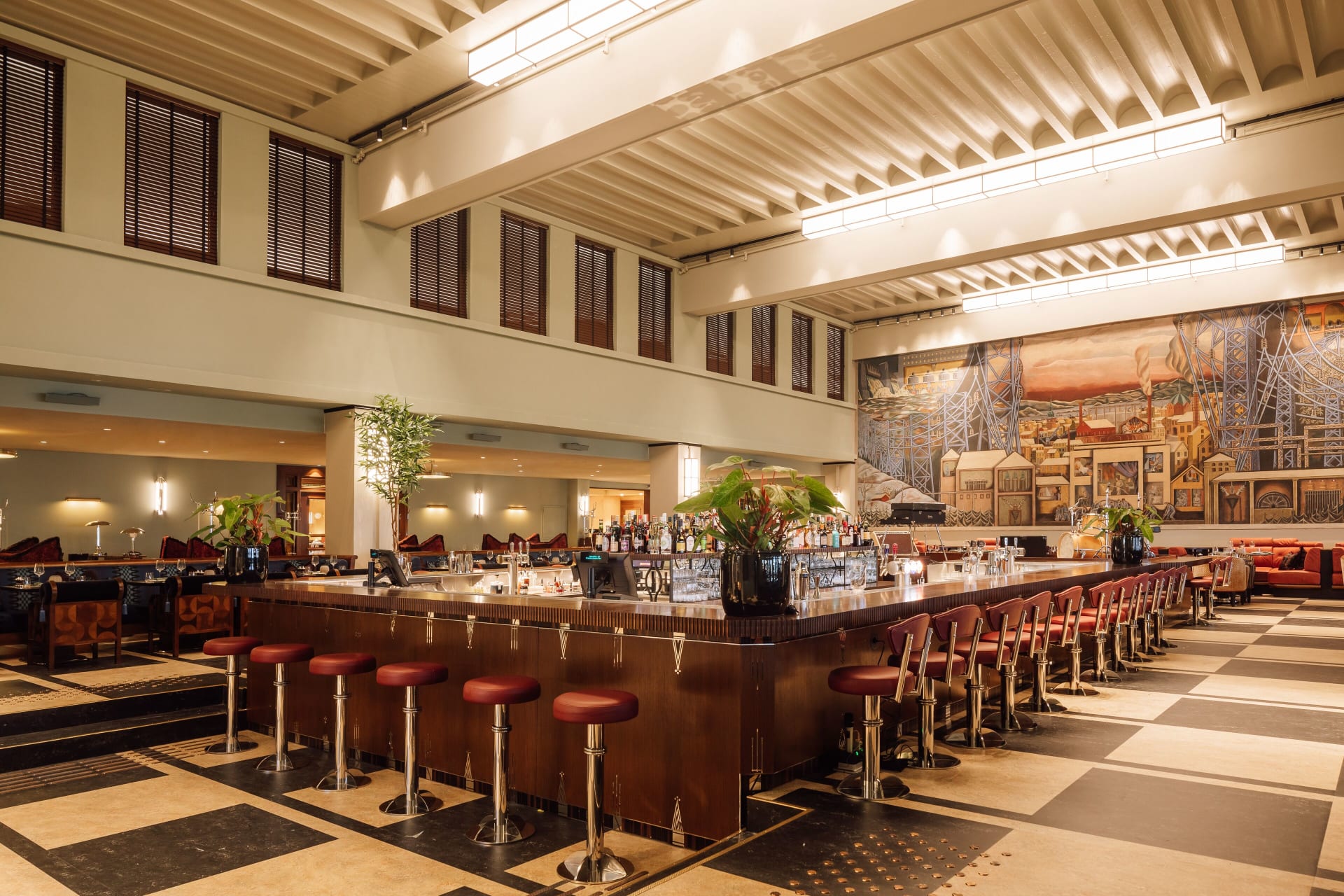
Ekspedisjonshallen at Sommerro in Oslo seen from above, with full tables, the bar in the middle of the hall and Per Krohg's fresco on the end wall

Picolo special

Light, power and heat: an electric evening in Ekspedisjonshallen at Sommerro

This is where the people of Oslo once paid their electricity bills over the counter. Today the house band plays jazz beneath Per Krohg's grand frescoes, and Ekspedisjonshallen has become the capital's liveliest living room.

5 November 202613 min read

© Francisco Nogueira / Strawberry

Picolo has a commercial partnership with Strawberry. This page contains affiliate links. If you book through them, Picolo earns a commission at no extra cost to you.

In short: Ekspedisjonshallen

Ekspedisjonshallen is the brasserie at Sommerro by Solli plass in central Oslo, in the old headquarters of Oslo Lysverker, the city's electricity company. The hall has Per Krohg's original frescoes, and the kitchen is open from breakfast until late dinner. The house band plays jazz every week.

You can also book Sommerro through Hotels.com: Check availability and prices.

Last checked: November 2026.

Our first choice: Sommerro, the hotel around the hall. See rooms and prices at Sommerro

The music reaches you on your way in. You enter from Sommerrogata, and in the middle of the magnificent room stand the five musicians. Look up and you see the protected frescoes from 1931 high on the end wall, painstakingly uncovered after being hidden from the people of Oslo for decades. The bar winds through the room and is a welcome spot for guests who did not manage to get a table.

We have sat here many times, for jazz, for dinner and with a glass from the well-stocked wine cellar. Every time it strikes us that not even the most imaginative among us could have pictured the world that now lives inside the old power company. At the counters in this hall, people in Oslo paid their electricity bills from the 1930s. Now it feels like stepping into the lively establishments we know from Paris or New York. The British magazine Suitcase describes the brasserie as built around what were once the power company's cash registers.

The hall kept its name. And the frescoes. Everything else is gone.

Sommerro opened the doors to the old power company headquarters on 1 September 2022, and Ekspedisjonshallen became the hotel's brasserie. Food is served from morning to evening, and several times a week the house band plays jazz. Live jazz.

Chapter 1 · The power

1892

Christiania Elektricitetsværk

The city gets electricity

Oslo got its electricity works on 12 December 1892. Eight years later came Hammeren in Maridalen, today the oldest hydropower plant still running in Norway. The city embraced the new phenomenon, and the company soon needed a new headquarters.

Chapter 2 · Lysverket

1931

The building at Solli plass is finished

Three words on the facade

The architects Andreas Bjercke and Georg Eliassen spent fourteen years on the building. Three words stand on the facade: light, power, heat. The same year Per Krohg painted the frescoes in the customer hall, where the city paid its electricity bills over the counter.

Chapter 3 · 1932

150,000

visitors a year at its busiest

The bath beneath the floor

The city demanded a public bath in the basement. Vestkantbadet opened in 1932, and above the pool Per Krohg's mosaic shows bathing women and seals, with a walrus in the middle.

Chapter 4 · 2022

231

art deco rooms and suites

Five years and a pandemic

Petter Stordalen and Aspelin Ramm rebuilt the house, and Sommerro opened on 1 September 2022. The customer hall became a brasserie, and TAK and the pool arrived on the roof.

Today

Jazz beneath the frescoes

The house band plays every week, and from 10 pm the minimum age is 25. The hall kept its name. And the frescoes.

Travel facts

When to go. The house band plays every week, often with a guest singer, and the programme is on Ekspedisjonshallen's page. Weekends and the weeks before Christmas fill up, so book a table.

Getting there. The address is Sommerrogata 1, behind the Royal Palace. From Nationaltheatret station it is around a ten-minute walk, and the Airport Express Train from Gardermoen stops there. The tram stops at Solli plass.

Where to stay.

Sommerro is the obvious choice. The hotel has 231 art deco rooms and suites, and Vestkantbadet in the basement is part of the stay for hotel guests. The rooftop pool is reserved for suite guests and those who book a wellness package. Ekspedisjonshallen is a lift ride away. More about the rooms on our Sommerro hotel page. See rooms and prices at Sommerro

Clarion Collection Hotel Savoy is by Tullinløkka, with 92 rooms and its own restaurant. The hotel has a sauna and a garden, and you are a short walk from both the museums and Karl Johans gate.

Karl Johan Hotel suits you if you want art deco in your room too. The hotel has 157 rooms and is three minutes from the Parliament, with a short walk to the Palace Park.

More hotels are in our list of the ten best luxury hotels in Oslo.

Where to eat. Ekspedisjonshallen is a brasserie all day. In the same building you will find TAK on the roof and the izakaya, among others. If you want to explore more of the city, we have gathered Oslo's cosiest restaurants.

Book ahead. Tables on jazz nights should be booked early, especially at weekends. The same goes for treatments at Vestkantbadet and hotel rooms in December.

What it costs. A day ticket to Vestkantbadet costs 325 kroner for non-residents, towels included. Room prices at Sommerro vary a lot through the year, so check the rate of the day via the link above. Menus with prices are on Ekspedisjonshallen's page.

Light, power and heat

Oslo got its electricity works on 12 December 1892. At the time it was called Christiania Elektricitetsværk. Eight years later the company built its first hydropower plant, Hammeren in Maridalen. According to the Norwegian encyclopedia Store norske leksikon, it is still running and is today the oldest hydropower plant in operation in Norway.

The people of the city eagerly took up the new phenomenon, electricity, and the company grew fast. Eventually it needed a new headquarters. The site was by a square with a long history. The name Solli comes from an estate that was held together from 1716 to 1822. The last owner was Claus Pavels, and after him the estate was divided up. Solli plass got its name in 1885. The power company built its headquarters on the north-west corner of the square.

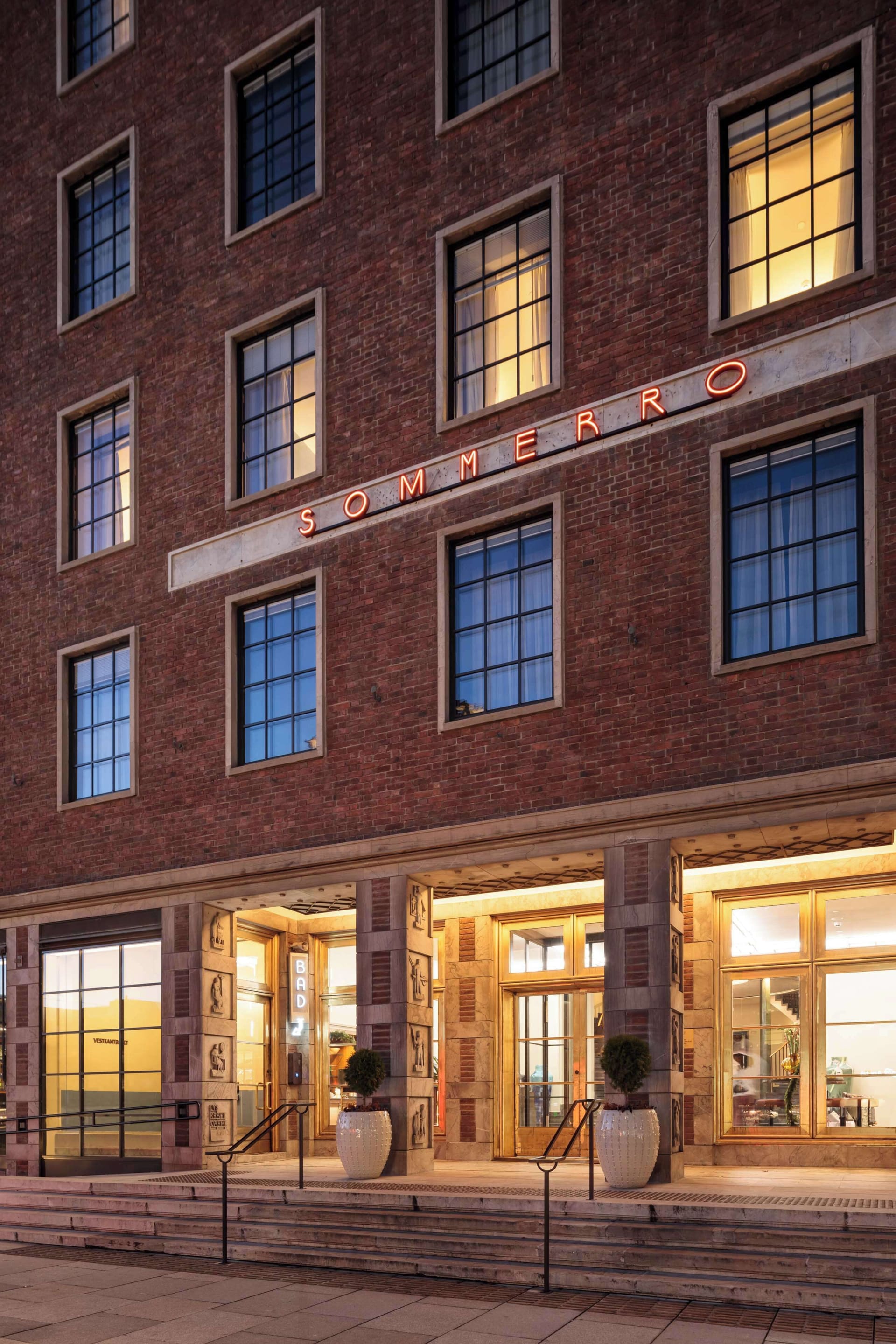
The commission went to the architects Andreas Bjercke and Georg Eliassen. Work began in earnest in 1917, and the building was ready in 1931. The same year the company took the name Oslo Lysverker. The building is red brick, and the style sits somewhere between neoclassicism and functionalism, with a touch of art deco in the details.

Three words on the facade sum up what the building held: light, power, heat. The sculptor Asbjørg Borgfelt made 24 reliefs on the pillars outside. They are worth a walk around the building before you go in.

Two architects and a power company

Bjercke was born in Kristiania in 1883. From 1914 he ran an office with Eliassen, and the year before they had won the competition for the Seamen's School in Oslo. It was finished in 1917, the same year work on Lysverket got properly under way. You can see the handsome Seamen's School up on the Ekeberg ridge. Today it is schoolchildren who stream through its doors.

They later also designed the clubhouse and restaurant Dronningen for the Royal Norwegian Yacht Club. Store norske leksikon sums up their work like this: the buildings reflect the development of the profession at the time, but all share the same sense of quality (Picolo's translation). Lysverket is a good example. The building took fourteen years to complete, and the style changed gradually along the way.

Bjercke and Eliassen also designed the headquarters of the Norwegian America Line at Jernbanetorget. Today both buildings are luxury hotels in the same chain. Two of Oslo's most talked-about hotels are in buildings from the same drawing board. One was designed for a power company, the other for a shipping line that carried emigrants to America. Both are on our list of the ten best luxury hotels in Oslo.

The painter from Paris

The artist Per Krohg was the son of Christian and Oda Krohg and grew up in Paris. He trained with his father and later with Henri Matisse. When he painted the electricity-themed frescoes for Lysverket in 1931, he had already decorated Grand Café in 1928, a few hundred metres further south.

The encyclopedia describes the commission like this: in 1931 he depicted the uses of electricity in a large fresco at Oslo Lysverker (Picolo's translation).

At the same time he was working on a ceiling painting at Kunstnernes Hus, in the same part of town. Some twenty years later he would paint the main wall of the UN Security Council chamber in New York. From 1946 he was a professor at the National Academy of Fine Arts, and in his final years before retiring he led the academy. So it was no ordinary painter who decorated Ekspedisjonshallen.

The fresco in Sommerrogata is far less known than the wall in New York, but painted by the same hand. Here the subject is not world politics but what electricity could do for ordinary people on an ordinary day.

During the rebuild the ceiling paintings were covered up.

Most of what we see here will be preserved and restored, project manager Sverre Bringsrud Fekjær of Insenti told Byggfakta while work was under way. The building also has its own Krohg hall in the artist's memory. According to the trade magazine Næringseiendom, the ceiling paintings there were long almost unknown. The bar in the hall is designed after 1930s Scandinavian art deco, and the sunken floor is in fact the original from 1931.

The sculptor and the bears

Asbjørg Borgfelt was only 31 when the reliefs on the facade of Lysverket were finished. She had already made the Bear Fountain at Majorstua in 1926 and the Ox Fountain at Torshov in 1929, and these animal sculptures became her trademark. According to the encyclopedia, she made reliefs for the two architects at Oslo Lysverker in 1931, at the Norwegian Shipowners' Association in 1935 and at the Norwegian Employers' Association in 1950. Lysverket was the start of a long collaboration.

To see more of Borgfelt, walk to the Bear Fountain at Majorstua. You can also visit the Christian Krohg statue by Stortingsplassen, which she made with the sculptor Per Hurum. The statue was unveiled in 1960 and depicts the father of Per Krohg, the man behind the frescoes in Ekspedisjonshallen. Take one in the morning and the other on your way to dinner.

FrognerPalace ParkMajorstuenCentreSommerroKunstnernes HusKarl JohanMajorstuaFrogner Park

Simplified map. The routes show direction, not streets.

A morning on foot

Krohg and Borgfelt around town

The frescoes in Ekspedisjonshallen are just the start. Scroll to walk on to the rest of the art from the same hands.

  • On foot

On foot

Krohg on the ceiling

While painting the frescoes at Lysverket, Per Krohg was also working on a ceiling painting at Kunstnernes Hus, in the same part of town.

  • Per Krohg
  • ceiling painting

On foot

Grand Café and Krohg the father

Krohg decorated Grand Café in 1928, a few hundred metres south of Lysverket. By Stortingsplassen stands the Christian Krohg statue, made by Asbjørg Borgfelt and Per Hurum and unveiled in 1960.

  • Grand Café
  • Christian Krohg statue

On foot

The Bear Fountain

Borgfelt's Bear Fountain from 1926. The animal sculptures became her trademark, and five years later she made the reliefs on Lysverket.

  • Asbjørg Borgfelt
  • 1926

On foot

Vigeland's sculptures

West of Solli plass lies Frogner Park with Vigeland's sculptures. You can do it in a morning and be back for lunch in Ekspedisjonshallen.

  • Vigeland Park

Vestkantbadet for everyone

The city set one condition when Lysverket built its headquarters: the basement had to have a public bath open to all. Vestkantbadet opened in 1932 and cost the tidy sum of 400,000 kroner, according to Sommerro's fact sheet. It became popular, and at its busiest the bath had as many as 150,000 visitors a year.

In the 1990s the city wanted to close Vestkantbadet. But a friends' association took over and kept the bath open for many years, until it closed when the building was sold and rebuilt.

The pool is not large, measuring 12.5 by 10 metres. Above the water Per Krohg's mosaic shows bathing women and seals, with a walrus in the middle. The original pool with Per Krohg's mosaic has of course been well preserved, Sommerro's brand director Siri Løining told the media before the reopening.

The bath is protected. The restoration followed archive photos and original drawings, and the handmade tiles were carefully repaired or replaced one by one. The changing cubicles from 1932 were sanded down and varnished again. The entrance rotunda got back its original colours and patterns on floor and ceiling, and the old chairs and ticket window are still there.

The Norwegian Institute for Cultural Heritage Research was responsible for conserving the art. Borgfelt is represented down here too, with a bronze bear relief by the old Roman bath. The Roman bath is now an infrared sauna with a cold plunge, and the old wash rooms are used for therapeutic treatments. In all the bath has 18 treatment rooms, and a new gym has been built into the same complex. The old public bath has become Oslo's largest wellness centre, according to the owners.

The city's heritage office followed the work closely. Everyone involved has done a brilliant job here, said city conservator Janne Wilberg when the bath reopened, and the property company was just as pleased. Vestkantbadet has always been a jewel, said CEO Gunnar Bøyum of Aspelin Ramm (quotes in Picolo's translation).

The pool is part of the stay for hotel guests, but it is also open to others at set times: Monday to Thursday from 7 am to 9 pm, Friday from 7 am to 8 pm and Sunday from 2 pm to 8 pm. The minimum age is 16, and a day ticket costs 325 kroner. Bring swimwear.

View from the rooftop sauna at Sommerro towards the rooftop pool and the trees of FrognerFrancisco Nogueira / Strawberry

A sauna with a view


From the rooftop sauna you look straight out over the pool, which is reserved for suite guests and wellness packages. The bath in the basement is open to all hotel guests.

Five years and a pandemic

The old Lysverket became Oslo Energi in 1991, and the company was split up a few years later. The old headquarters was left without a natural owner. Hotel magnate Petter Stordalen and the property company Aspelin Ramm took it on. The rebuild was designed by LPO Arkitekter, the interiors by the design studio GrecoDeco, and the city's heritage office followed the work closely.

It has been five demanding years of building in the middle of a pandemic, said hotel director Jarle Moen when the hotel opened. Stordalen made no secret of what he felt he had in his hands.

The building is a tribute to Norwegian design and cultural heritage, he said in the press release from the opening (Picolo's translation).

Inside, the designers chose a calmer line than the facade. We avoided pretentiousness in the design, Adam Greco of GrecoDeco told Hospitality Design. You notice it in Ekspedisjonshallen. The room is large, but the chairs are made for sitting in for a long time.

Even before the opening, Moen had said what the hall should become: an extra living room for when you want to be social, he told Næringseiendom. After many evenings here, we are convinced he got it right.

A day in the hall

Most people know Ekspedisjonshallen as an evening place. By day it is a different room.

Breakfast starts at 7 am on weekdays and 8 am at weekends. Lunch is served on weekdays between 11 am and 2 pm, and at weekends brunch takes over from noon.

Dinner starts at 4 pm on weekdays and 5 pm at weekends. From 10 pm the minimum age is 25, and the music and the bar take over. The menu is classic French brasserie, and in the evening it changes with the seasons. The bar also has its own alcohol-free cocktail menu, and the wine list is on Sommerro's website.

The roof terrace at Sommerro with views over Frogner in OsloHotels.com (Expedia Group)

TAK on the roof


The rooftop restaurant TAK Oslo and its terrace look out over Frogner, one of several kitchens in the building.

Restaurants for every occasion

Ekspedisjonshallen is just one of several restaurants and bars in the building. On the roof is TAK Oslo, with views over Frogner. You will also find To Søstre, Barramon, Plah and an izakaya with a bar and terrace, as well as the bar Prohibitionists, which nods to Prohibition-era America.

With so many kitchens under one roof, you can stay three nights without eating in the same place twice, and without going out in the rain. Lysverker Scene and the small, exclusive cinema are just a few stairs away.

If you are planning a work party or celebrating an anniversary, Sommerro is practical too. Dinner can be in one chosen restaurant and the rest of the evening in the buzzing Ekspedisjonshallen.

Frogner around the corner

Sommerro sits where Frogner, one of the city's most expensive districts, begins. Behind the hotel starts the Palace Park, and a short walk through the park takes you to the Royal Palace and Karl Johans gate.

Walk north from Solli plass and you reach the shopping streets Hegdehaugsveien and Bogstadveien, with popular shops and cafés. To the west lies Frogner Park with Vigeland's sculptures. You can reach both on foot in a morning and be back for lunch.

If you have an extra day in the city, the best tips are in Picolo's Oslo guide. There you will also find places to eat all over Oslo and hotels in every price range.

Aftenposten Vink called Ekspedisjonshallen the finest restaurant room in Oslo. A small tip: if you want to talk freely with your friends at the table, ask for a table some way from the music. Lunch is another option, as the hall is quieter then.

Around Christmas many people use the hall for traditional Norwegian Christmas parties, and then it is often full well in advance.

How we would plan the evening

If you stay at Sommerro, you need more than one night to take it all in. This is how we would do it:

Head to Vestkantbadet around five, before the dinner guests arrive. Then a visit to the gym, before a quick stop in the room to shower, change into something smart and take the lift down to the jazz, the atmosphere and your table at seven. Stay until the last set. You do not have to think about the tram home. The only thing you have to tackle is the steps up from the bar. The next morning breakfast is served from 7 am in the same hall as the jazz the night before.

If you want the rooftop pool as part of your stay, you need to book a suite or a wellness package. For most people the bath in the basement is enough. It is older and, in our view, even more beautiful.

If you have another evening, there is more in the building than food and drink. Lysverker Scene seats an audience of 150, and Sommerro also has a small but exclusive cinema. The film programme is on the hotel's website and is worth checking before you book a room.

The hotel has collected a string of top awards since it opened. The Michelin Guide has given Sommerro one of its hotel keys. According to the hotel itself, Sommerro was named best hotel in Norway at the Grand Travel Awards three years in a row from 2022. See rooms and prices at Sommerro.

The hotel is made so that you do not even need to step outside the door during your stay. The words are still there on the wall: light, power, heat.

Our first choice in Oslo

Sommerro


Sommerro is the hotel for you if you want to stay in a piece of Oslo history without giving up comfort. The old power company headquarters has 231 art deco rooms and suites. In the basement is Vestkantbadet with its mosaic from 1932, and suite guests also have a pool and sauna on the roof, which the hotel calls the city's first. In between are Ekspedisjonshallen, TAK and several more restaurants and bars. You stay in Frogner with the tram outside the door and a ten-minute walk to Nationaltheatret.

See rooms and prices at Sommerro

Frequently asked questions about Ekspedisjonshallen

What was Ekspedisjonshallen before?

Ekspedisjonshallen was the customer hall in the headquarters of Oslo Lysverker, where people paid their electricity bills over the counter. The building at Sommerrogata 1 was finished in 1931 and designed by the architects Andreas Bjercke and Georg Eliassen. Per Krohg painted a large fresco on the uses of electricity for the building. Since 2022 the hall has been the brasserie at the Sommerro hotel.

Where is Ekspedisjonshallen?

Ekspedisjonshallen is in the Sommerro hotel at Sommerrogata 1 by Solli plass in Frogner, Oslo. From Nationaltheatret station it is around a ten-minute walk, and the tram stops on the square outside. You do not need to stay at the hotel to eat there, but it is worth booking a table in the evening and at weekends.

When is there jazz in Ekspedisjonshallen?

Sommerro's house band plays jazz in Ekspedisjonshallen every week, often with guest singers. Evening concerts usually start between 7 and 8 pm, and on some days there is also music in the daytime. The programme varies through the season, so check Sommerro's website before you book a table. Remember the minimum age is 25 from 10 pm.

What is Vestkantbadet?

Vestkantbadet is the public bath in the basement at Sommerro, built in 1932 as part of the power company headquarters. The pool measures 12.5 by 10 metres, and above the water you see Krohg's mosaic of bathing women and a walrus. The bath is protected and was restored tile by tile before reopening as a wellness centre.

Can anyone use Vestkantbadet?

Yes, Vestkantbadet is also open to people not staying at Sommerro, but only at set times: Monday to Thursday 7 am to 9 pm, Friday 7 am to 8 pm and Sunday 2 pm to 8 pm. A day ticket costs 325 kroner with towels, and the minimum age is 16. Hotel guests have the bath as part of their stay. Treatments are booked separately.

Do I have to stay at Sommerro to eat in Ekspedisjonshallen?

No, Ekspedisjonshallen is open to everyone, and Sommerro itself calls it the neighbourhood brasserie. The kitchen serves food from breakfast to evening on weekdays and brunch at weekends. For a table on a jazz night or before Christmas, book well ahead, especially for Fridays and Saturdays.

Sources

The history of Oslo Lysverker, Per Krohg, Andreas Bjercke and Asbjørg Borgfelt is based on Store norske leksikon. Construction dates come from Historic Hotels Worldwide and Sommerro's own pages, and facts about Vestkantbadet from Sommerro's fact sheet and Aspelin Ramm's announcement at the reopening. For the rebuild we have used Byggfakta and Næringseiendom, as well as Hospitality Design, Suitcase and the press release from the opening. Opening hours and the music programme are from Ekspedisjonshallen's page. The rest is our own observation from many evenings in the hall.

About the editors

Picolo is an independent Norwegian travel magazine, and the editors have been to Ekspedisjonshallen many times. A detail few people notice: the restaurant To Søstre in the same building takes its name from the working title the architects Bjercke and Eliassen gave the project. More from the city in Picolo's guide to Oslo.