
Tuscany
The cliff towns of Tuscany and Lazio: Pitigliano, Sorano, Civita and Orvieto
Towns that grow straight out of the rock, Etruscan sunken roads and hot springs: how to see the cliff towns in the borderland between Tuscany and Lazio, and where to stay.

Picolo Editorial
You see them from the road long before you arrive: towns that grow straight out of the cliffs, with houses in the same golden-brown stone as the rock beneath them. In the borderland between Tuscany and Lazio they sit close together, and with a car you can reach several in a day.
Short answer: the cliff towns of Tuscany and Lazio
The cliff towns stand on plateaus of tuff, a soft volcanic rock, in southern Tuscany and northern Lazio. The best known are Pitigliano, Sovana, Sorano and Civita di Bagnoregio, and Orvieto lies just across the border in Umbria. Stay in Sovana or near Saturnia for the Tuscan side, and in Bagnoregio or Orvieto for Civita.
The hotel links are partner links. If you book through them, Picolo may earn a small commission, at no extra cost to you.
Our first pick: Sovana Hotel & Resort, midway between Pitigliano, Sovana and Sorano. See rooms at Sovana Hotel & Resort
Pitigliano: Little Jerusalem
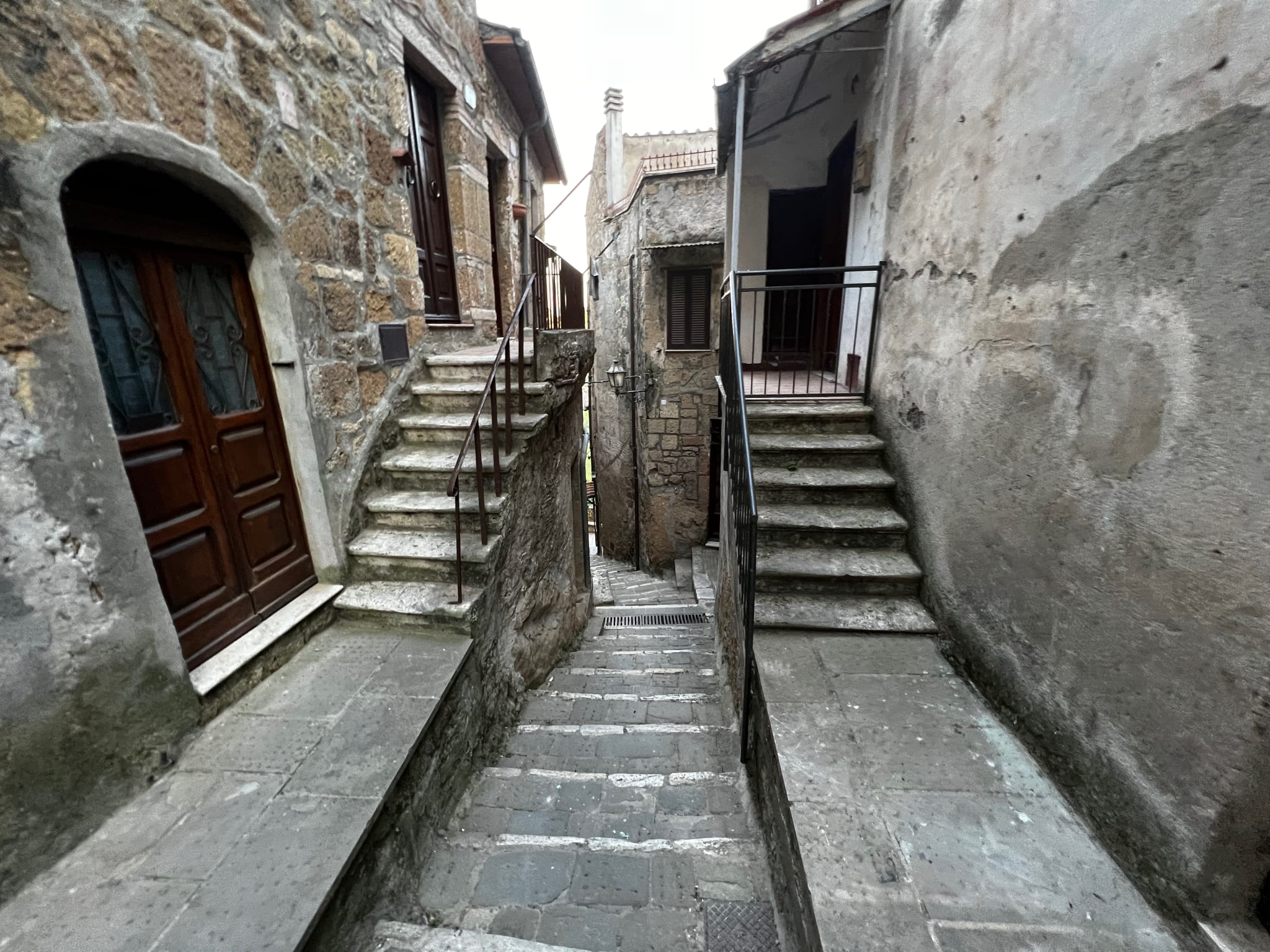
Pitigliano sits on a cliff above two river valleys in the Maremma, in the province of Grosseto. The houses are built from the same stone as the cliff, and the town is called Little Jerusalem after the Jewish community that lived here for several hundred years.
We have written about the story behind the name in our piece on Pitigliano. Try to arrive at sunset, when the facades glow red.
Sovana: Etruscan tombs
Sovana is a village with a single main street, around ten minutes from Pitigliano. Just outside lies an Etruscan burial ground with tombs cut into the rock, among them the Tomba Ildebranda.
Between the villages run the Etruscan sunken roads, the Vie Cave. These are narrow paths carved deep into the tuff, some more than ten metres deep. They are good walking, and in summer it stays cool between the walls.

Pitigliano
The houses of Pitigliano are built from the same tuff as the cliff they stand on.
Sorano: the fortress on the edge
Sorano lies just north of Pitigliano, on the edge of a deep valley. At the top stands the Fortezza Orsini, and the narrow streets below climb steeply towards it.
Sorano is quieter than Pitigliano and has fewer tourists. Set aside a morning for the old town and the fortress.
Saturnia: hot springs
Saturnia is not a cliff town, but the hot springs around half an hour from Pitigliano are the reason many people come this way. At Cascate del Mulino the warm water runs down into natural pools, and bathing is free.
If you want the springs to yourself, stay at Terme di Saturnia, the hotel at the source itself, where guests have their own thermal pools.
Civita di Bagnoregio: the town that is crumbling
Civita di Bagnoregio is in Lazio, around an hour from Pitigliano and 120 kilometres from Rome. The town stands on a cliff that is eroding, and only around ten people live here permanently. Read more in our piece on Civita di Bagnoregio.
You enter across a footbridge of around 300 metres from Bagnoregio. Entry cost 5 euros in 2026. There are cameras and fines in the area around the bridge, so park in Bagnoregio and walk the last stretch.

Civita di Bagnoregio
Civita di Bagnoregio stands on a cliff that is slowly crumbling away, and the footbridge is the only way in.
Orvieto: the cathedral on the cliff
Orvieto is in Umbria, around half an hour from Civita, on a high plateau of tuff. The cathedral has one of the most famous facades in Italy, and beneath the town is the well Pozzo di San Patrizio, with its double spiral staircase.
Orvieto is larger than the other towns, with more restaurants and trains to Rome and Florence. That makes it a practical place to stay if you arrive without a car.
How to plan the trip
You need a car to see the cliff towns. The three Tuscan towns are so close together that you can see all of them in a day. Civita and Orvieto are a separate day further east.
Spring and autumn are best. In July and August it is hot and crowded in the narrow streets, and in winter some restaurants may be closed.
Where to stay
For Pitigliano, Sovana and Sorano
Sovana Hotel & Resort is in the middle of Sovana, with a pool and a restaurant and a short drive to both Pitigliano and Sorano. Guests rate it 9.2 out of 10 on Hotels.com.
Book your stay: See rooms at Sovana Hotel & Resort
If you want luxury and hot springs, Terme di Saturnia is around half an hour away, with thermal pools and a golf course.
Book your stay: See rooms at Terme di Saturnia
For Civita and Orvieto
Palazzo Contino is in Bagnoregio, a short walk from the bridge to Civita, with 9.8 out of 10 from guests. In Orvieto, Hotel Duomo sits right beside the cathedral.
Book your stay: See rooms at Palazzo Contino
Book your stay: See rooms at Hotel Duomo
Frequently asked questions about the cliff towns of Tuscany and Lazio
Which cliff towns should you see in Tuscany?
The best-known cliff towns in Tuscany are Pitigliano, Sovana and Sorano in the Maremma, in the south of the region. They lie around ten minutes apart and are linked by the Etruscan sunken roads, the Vie Cave. Just across the border in Lazio is Civita di Bagnoregio, and in Umbria is Orvieto.
How far is it from Pitigliano to Civita di Bagnoregio?
It takes around an hour by car from Pitigliano to Civita di Bagnoregio. Many people see the Tuscan cliff towns one day and Civita and Orvieto the next. Without a car the small towns are hard to reach, so hire a car in Rome or Florence.
Does it cost anything to visit Civita di Bagnoregio?
Yes. Entry to Civita cost 5 euros in 2026 and is paid before you cross the footbridge from Bagnoregio. The ticket goes towards maintaining the town. Park in Bagnoregio, as the area around the bridge has cameras and fines for cars without a permit.
Read more
ENJOY THE CLIFF TOWNS
Picolo Editorial