
Yellowstone
The Yellowstone supervolcano: what lies beneath, and is it safe to visit?
The geysers, the boiling springs and the strange smell of sulphur share one explanation: Yellowstone sits on top of one of the largest volcanic systems on Earth. Here is what scientists actually know, why there is no need to postpone your trip, and where to see the volcano best.
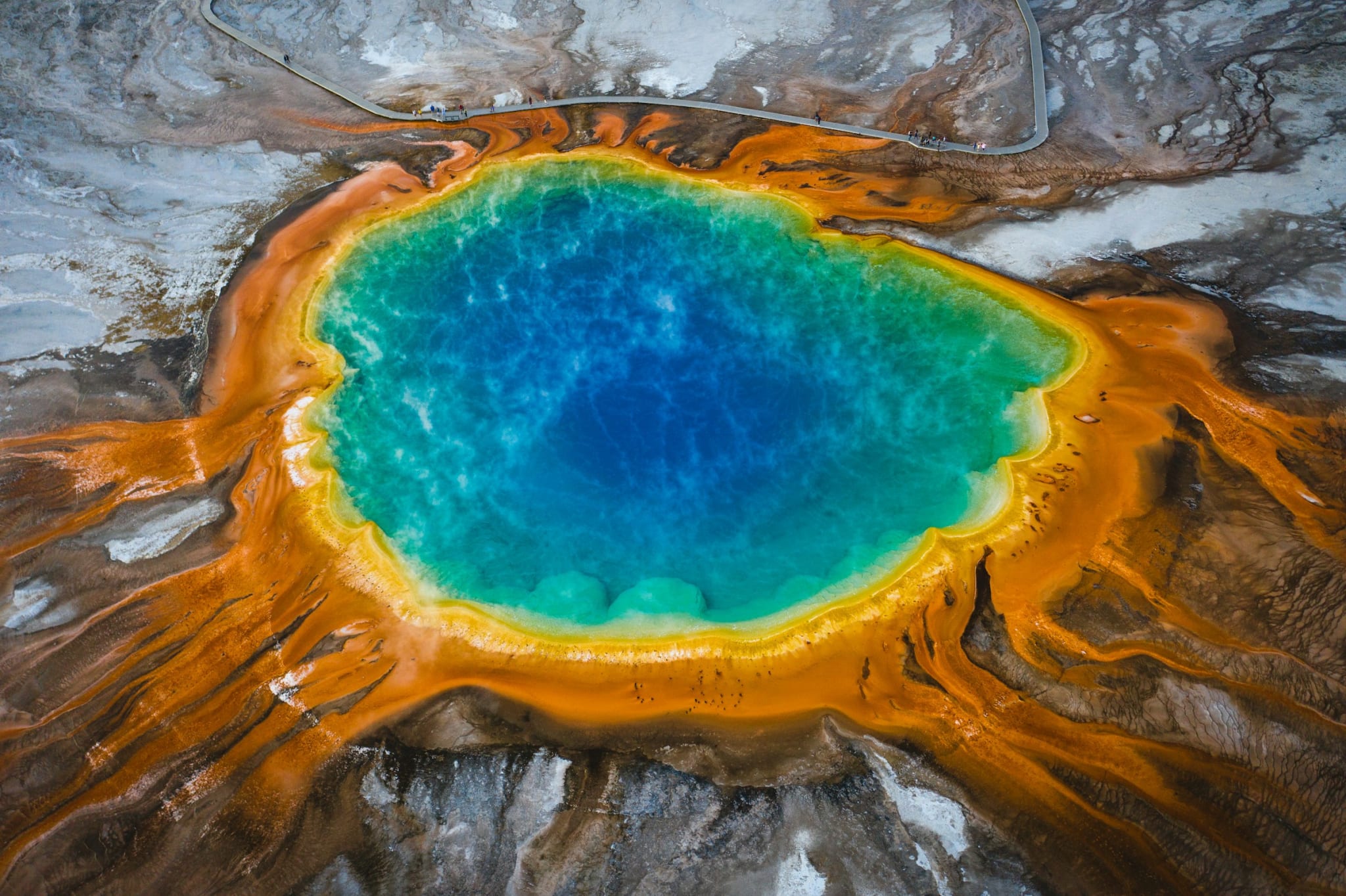
From the overlook above Grand Prismatic Spring, the pool looks like a giant eye: deep blue at the centre, ringed with yellow, orange and red. It is easy to forget that all of this, the geysers, the bubbling mud pots and the bright pools, has the same explanation: right beneath your feet lies one of the largest volcanic systems on Earth. The question many people ask before they travel is simple. Is it safe?
The links to the hotels are partner links. If you book through them, Picolo may earn a small commission at no extra cost to you.
Short answer: is it safe to visit Yellowstone?
Yes. According to the US Geological Survey, the yearly probability of another supereruption is around 1 in 730,000, and scientists see no sign that an eruption is imminent. The real dangers in the park are far more everyday: boiling water off the boardwalks and wild animals approached too closely.
Stay in the heart of the volcano
By the geysers: Old Faithful Inn, right beside Old Faithful. See rooms at Old Faithful Inn
By the caldera lake: Lake Yellowstone Hotel, on the shore of Yellowstone Lake. See rooms at Lake Yellowstone Hotel
What lies beneath Yellowstone?
Much of the park sits inside a caldera, a vast depression formed when the ground collapsed after a gigantic eruption. Beneath it lies a magma reservoir, a zone of partly molten rock deep in the Earth’s crust. Its heat drives the geysers and hot springs.
Three supereruptions in two million years
Yellowstone has had three huge eruptions: around 2.1 million, 1.3 million and 640,000 years ago. The last formed the caldera that shapes the landscape today. Since then there have been around 80 smaller, far gentler eruptions, mostly lava flows. The most recent was around 70,000 years ago.

Yellowstone Lake, which lies partly inside the caldera.
Watched around the clock
The Yellowstone Volcano Observatory, a partnership between the USGS, the national park and the University of Utah, tracks earthquakes, ground movement and volcanic gases. The park has between 1,000 and 3,000 earthquakes a year, almost all too small to feel. According to scientists, the most likely next eruption is not a supereruption but a slow lava flow inside the caldera.
The myth that Yellowstone is “overdue”
You may have read that the volcano erupts every 600,000 years and is therefore overdue. It is not true. Three eruptions are far too few to establish a pattern, and the gaps between them have varied widely.
Where to see the volcano in action
Grand Prismatic Spring: the largest hot spring in the USA, ringed by colourful bacterial mats. Climb to the overlook to see the colours from above.
Old Faithful: the geyser that erupts roughly every hour and a half, and made the park world-famous.
Mud Volcano: bubbling mud springs and the smell of sulphur, near Yellowstone Lake.
Yellowstone Lake: a large lake that lies partly inside the caldera.
The real danger: the springs and the wildlife
Every year visitors are injured after leaving the boardwalks. The ground around the springs can be as thin as a crust, with boiling water beneath. Stay on the paths, and keep at least 25 yards from bison and 100 yards from bears and wolves, as the park advises.
Frequently asked questions about the Yellowstone volcano
Could Yellowstone erupt?
Yes, the volcano is active, but the yearly probability of a supereruption is around 1 in 730,000, according to the USGS.
When did Yellowstone last erupt?
The last supereruption was around 640,000 years ago. The most recent lava flow came around 70,000 years ago.
Is it safe to visit Yellowstone?
Yes. Scientists see no sign of an imminent eruption. Follow the park rules, stay on the paths and keep your distance from wildlife.