
Where to go
The best places to visit in Scotland, from Edinburgh to Islay
Edinburgh and the Highlands are only the start. These are the places we put first in Scotland, when to go, and where to stay along the way.
This page contains affiliate links. If you book through them, Picolo earns a commission at no extra cost to you. Our picks are made independently by our editors.
In short: where to go in Scotland
With a week, start in Edinburgh, spend a day in Glasgow, then head north to Inverness and the Isle of Skye. With longer, add St Andrews, Islay for whisky or the North Coast 500. On a first trip, fewer stops will give you more.
Best for a city break: Edinburgh
Best for music and art: Glasgow
Best for landscapes: Isle of Skye
Best for golf: St Andrews
Best for whisky: Islay
Our first choice in Scotland: Check availability and prices at Old Course Hotel
An hour north of Edinburgh the train leaves the stone tenements behind, and the window fills with heather, sheep and lochs the colour of slate. That is the first lesson of Scotland: it looks small on a map and feels enormous once you are in it. Distances are short, roads are narrow, and days disappear faster than planned.
We have picked ten places for different reasons: cities for culture and food, islands for wild landscapes and whisky, and the coast for golf and castles. For each one you will find when to go, the thing to know before you book, and the hotel we choose. For transport, food and planning in more depth, see our Scotland travel guide.

Prestonfield House
In the drawing rooms at Prestonfield House you sit among dark wood and red fabrics, with the parkland just outside.
Edinburgh: castle, festivals and the Old Town
Most trips begin in Edinburgh, and for good reason. The medieval Old Town and the Georgian New Town are a UNESCO World Heritage Site, and the castle sits on an ancient volcanic plug in the middle of the city. Arthur's Seat, a hill you can climb in a morning, rises just beyond the houses.
August is festival month, when the Fringe fills every cellar and church hall with comedy and theatre. The rest of the year the city is calmer, and still full of pubs, bookshops and very good restaurants.
The caveat: in August hotel rooms are scarce and expensive. Book months ahead, or come in May or September instead.
Prestonfield House: a country house below Arthur's Seat
Prestonfield House is a 17th-century mansion set in parkland at the foot of Arthur's Seat, with peacocks wandering the lawns. Inside it is all dark panelling, red fabrics and candlelight, closer to a stage set than a chain hotel. Ideal for couples who want the city close but would rather sleep in the country.
Book your stay: Check availability and prices at Prestonfield House

Greywalls
At dusk the windows of Greywalls glow above the walled garden.
East Lothian: gannets and golf at North Berwick
A short train ride east of Edinburgh, North Berwick is a small seaside town with two beaches and a view of Bass Rock. In summer the island turns white with gannets, one of the largest colonies of its kind anywhere. Boat trips leave from the harbour, and the Scottish Seabird Centre sits by the pier.
This stretch of coast is also golf country, with Muirfield and several classic links courses. Non-golfers get long walks by the sea and a slower pace than the capital.
Greywalls: the garden after the round
Greywalls is a country house in Gullane designed by the architect Edwin Lutyens, with a walled garden and Muirfield next door. There are only a few rooms, and evenings are spent by the fire in the library. Choose it to stay quietly on the coast and take the train into Edinburgh for a day or two.
Book your stay: Check availability and prices at Greywalls
Glasgow: live music, museums and real city life
Glasgow is Edinburgh's more down-to-earth sibling, less than an hour away by train. It is known for live music, Victorian architecture and the work of Charles Rennie Mackintosh, and the Kelvingrove Art Gallery and Museum is free to enter. This is Scottish city life without the tartan souvenirs.
It is also the best jumping-off point for the west coast, with trains and buses to Loch Lomond, Oban and Fort William. The caveat: the centre is busier and less postcard-pretty than Edinburgh, so give it an evening before you decide.

Cameron House
The Carrick course at Cameron House runs along the water at the southern end of Loch Lomond.
Loch Lomond: where the Highlands begin
Loch Lomond is the largest lake in Britain by surface area and sits within Scotland's first national park. The southern shore is little more than half an hour from Glasgow, yet the further north you go, the steeper the hills and the fewer the houses. The West Highland Way long-distance path follows the eastern bank.
Take a boat onto the water, walk a stretch of the path or drive on through the Trossachs. The caveat: on sunny summer weekends the lochside roads fill with day-trippers from the city.
Cameron House: spa, golf and a jetty on the loch
Cameron House stands at the southern end of Loch Lomond, with its own golf course along the shore, a spa and a jetty for boat trips. It is a big resort that suits families and couples who want lochs and hills close by without driving far from Glasgow and its airport.
Book your stay: Check availability and prices at Cameron House

Old Course Hotel
From the Old Course Hotel you step straight out onto golf’s most famous course.
St Andrews: the home of golf, by the sea
St Andrews is a small university town on the Fife coast, with a ruined cathedral, the long West Sands beach and the Old Course, where golf has been played for centuries. The university is the oldest in Scotland, which gives the place a young buzz during term.
You do not need to play to enjoy it. Walk the beach early, explore the ruins above the sea and eat fish down by the harbour. The caveat: during major tournaments prices soar and rooms vanish.
Old Course Hotel: rooms above the Road Hole
The Old Course Hotel overlooks the 17th hole of the famous course, with a spa and many rooms facing the fairways and the sea. It is the obvious base for a once-in-a-lifetime golf trip, and just as comfortable for anyone who simply wants the beach and town close at hand.
Book your stay: Check availability and prices at Old Course Hotel

Dunnottar Castle
The ruins are surrounded by sea on three sides.
Stonehaven and Dunnottar: the castle on the cliff
South of Aberdeen, the ruins of Dunnottar Castle sit on a cliff-top plateau with the sea on three sides. In the 17th century the Scottish crown jewels were hidden here from Oliver Cromwell's army. A coastal path runs from the fishing town of Stonehaven to the castle, a walk of a couple of hours there and back.
Go early, before the coaches. The caveat: the wind can be fierce at the top, and the steps down towards the castle are steep.

The Highlands
Canoeing on one of the Highland lochs.
Inverness and Loch Ness: gateway to the Highlands
Inverness is the capital of the Highlands and the natural hub for onward travel. Loch Ness begins just south-west of the city and runs for close to 40 kilometres, with the ruins of Urquhart Castle on its shore. The battlefield of Culloden, scene of the 1746 battle, is a short drive east.
Use Inverness as a base for two or three nights, or as the start of the North Coast 500. The caveat: in summer, midges, tiny biting flies, swarm on still days. Pack a good repellent.
Isle of Skye: rock pinnacles and single-track roads
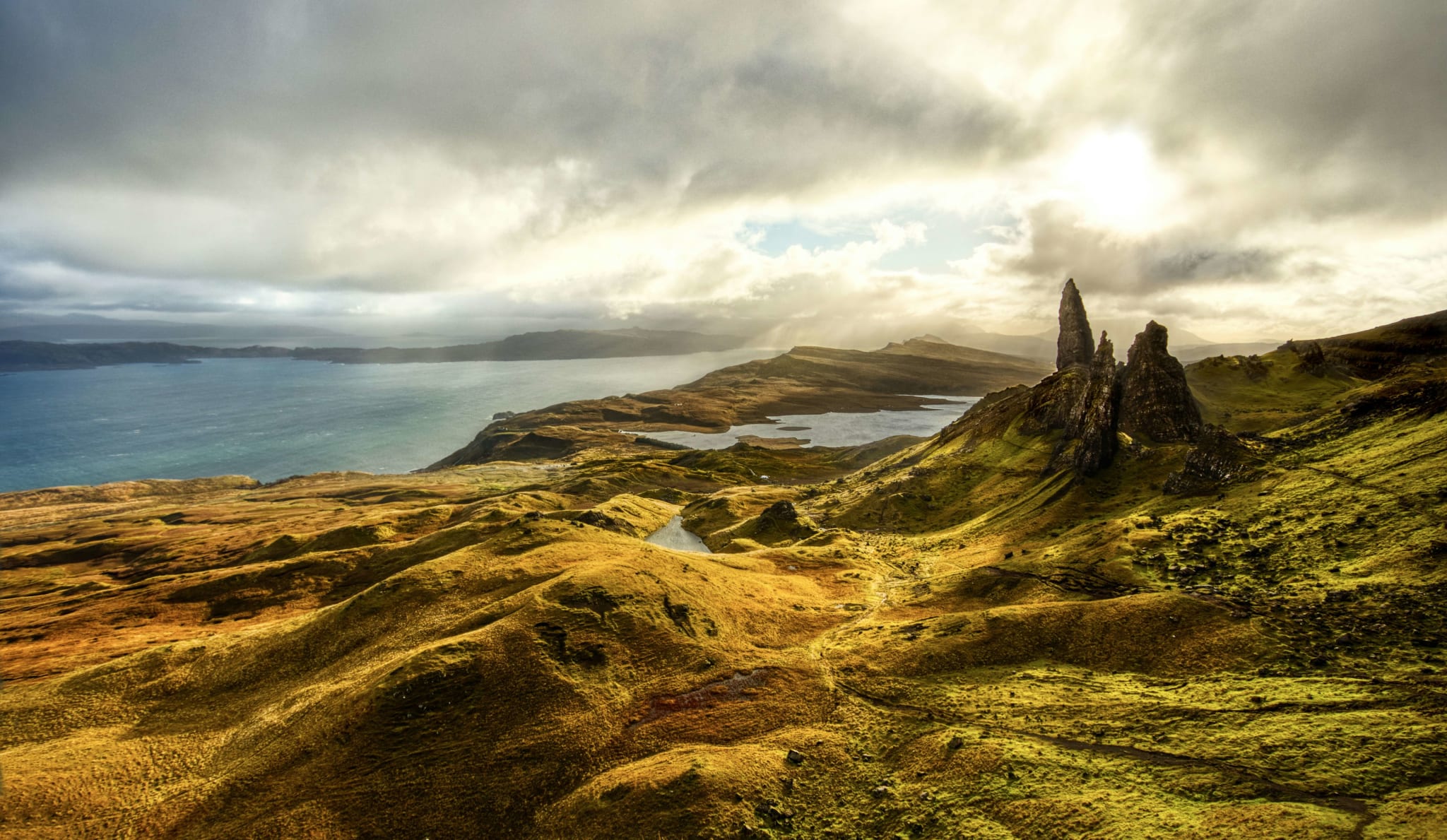
Skye is the island on every poster, and it lives up to it. The Old Man of Storr, the strange landslip scenery of the Quiraing and the clear Fairy Pools are all within a day's drive. The island has been linked to the mainland by bridge since 1995.
Come in May or September if you can, when the days are long and the roads quieter. The caveat: accommodation on the island books out early in summer, and many roads are single track with passing places. Plan shorter days than the map suggests.

Royal Golf Hotel
From the lounge at the Royal Golf Hotel you look out over Royal Dornoch and the Dornoch Firth.
Dornoch and the far north: the North Coast 500
The North Coast 500 is a loop of just over 800 kilometres that starts and ends in Inverness and follows the northern edge of the Highlands. Expect white beaches, ruined castles and glens with almost nobody in them. Dornoch, with its cathedral and one of the country's most celebrated golf courses, makes a pleasant first or last night.
The route has become popular, so do not rush it. The caveat: on the narrowest stretches you will meet motorhomes, and fuel stations can be far apart.
Royal Golf Hotel: a lounge with a view of the links
The Royal Golf Hotel sits right beside Royal Dornoch, with a lounge whose windows look over the course towards the Dornoch Firth. Golfers come for the links, but it also makes a calm overnight stop for anyone driving the coast who prefers a small town to a roadside motel.
Book your stay: Check availability and prices at Royal Golf Hotel

The Machrie
The moon rises over The Machrie, among the dunes in the south of Islay.
Islay: peat smoke and distilleries
Islay is the island for a whisky pilgrimage. This is where many of the smoky single malts come from, and the distilleries line the coast with their own tours and tastings. You arrive by ferry from Kennacraig or by plane from Glasgow.
Between visits there are beaches, seabirds and quiet roads. The caveat: book distillery tours ahead and decide who is driving. This is not a place for a quick day trip.
The Machrie: links among the dunes
The Machrie lies among the dunes on the south of Islay, with a links course and a long beach just outside. After a day of distillery visits, the best seat is by the window as the light drops over the sea. A natural choice for whisky travellers who want to stay by the water.
Book your stay: Check availability and prices at The Machrie
Good to know before you book
May and September are often best: long days, fewer crowds and fewer midges than high summer.
August belongs to the festivals: Edinburgh is full and expensive, so book early if you plan to be there.
A hire car gives freedom, but take it slowly: you drive on the left, often on single-track roads. Trains and buses cover the cities well.
Pack layers: the weather changes quickly, even in July.
Editor’s pick
Old Course Hotel
The Old Course Hotel is where we choose to stay in Scotland. It runs alongside the 17th hole of the Old Course in St Andrews, where golf has been played for centuries, and many rooms look over the fairways towards the sea. West Sands is a short walk away. The hotel has a spa, and the town centre with its cathedral ruins and harbour is easy to reach on foot. It suits golfers on a dream trip and couples who want beach and town close by.


Frequently asked questions about Scotland
What is the most beautiful place in Scotland?
The Isle of Skye is the most beautiful place in Scotland for most visitors, with the Old Man of Storr and the Quiraing within a short drive of each other. Glencoe and the north coast come close. Visit in May or September, when the days are long and the single-track roads are quieter than in high summer.
How many days do you need in Scotland?
A week covers Edinburgh and Glasgow, with a trip into the Highlands. If you want to add the Isle of Skye or the north coast, allow ten days or more, because roads are narrow and distances take longer than the map suggests. Spend at least two nights in each place so you are not packing every morning.
When is the best time to visit Scotland?
May, June and September are the best months to visit Scotland, with long days and fewer visitors than in July and August. In August Edinburgh is full of festivals and expensive. Winter suits city breaks, Christmas markets and Hogmanay, Edinburgh’s New Year celebration, but daylight is short in the Highlands.
Do you need a car in Scotland?
Not in the cities, where trains and buses cover the main towns well. For Skye and the north coast a car makes the trip much easier, even though buses and ferries run. Remember that Scotland drives on the left and many roads are single-track with passing places, so plan shorter driving days than the map suggests.
Is Edinburgh or Glasgow better to visit?
Choose Edinburgh for the castle and the historic old town, and Glasgow for live music and a more everyday city life. The two are under an hour apart by train, so many visitors stay in one and take a day trip to the other. Glasgow is also the best base for Loch Lomond and the west coast.